Words by Shefa’a Qudah
Translation by Hiba Moustafa
Artworks by Omar
This piece is part of the “Fields of Gestures” issue
Mid 2025, the Union of Cultural and Artistic Workers issued a statement on boycotting an arts and culture foundation owned by a wealthy Palestinian-Jordanian family, triggering the start of a cultural war that shows no signs of abating so far.
Founded in 2017 by a family that owes its wealth to a US-registered fruit export company and other investments allowing it to own the land and buildings, the foundation has exhibition spaces, studios, and artist accommodations.
During covid-19, the foundation closed its doors, salary payments stopped, and contentions regarding its fiscal management arose. Within the same period, a staff member converted its rooms into low-cost accommodation, creating a live artistic community that inspired the wealthy family to adopt a permanent artist residency program as less costly and more vibrant. Thus, the foundation became a permanent center for artist residencies and workshops with and for both local and Western artists, and audiences.
The statement asserts that the Jordanian culture scene is dominated by a sort of class and intellectual superiority and that the institutional model of the said foundation is ruled by contradictions. It promotes contemporary art, yet its founder and president owns the largest share in a company that announced, in April 2023, the completion of deals to export kiwi to the Occupied Territories in cooperation with Israeli distributors. Thanks to the company, kiwi is now available from November to May of each season and is distributed by the company’s official Israeli distributors in the Israeli entity.
The company argues that its presence in the Israeli market is part of its market expansion across Europe, Africa, and the SWANA region, with the aim of strengthening its brand visibility for Israeli consumers.
This export of kiwi fruit to the Israeli market builds on the company’s previous activities there. In 2022, the company expanded its presence by introducing shelf-stable food products, including Del Monte canned goods, through partnerships with local importers and distributors. This move aimed to increase product sales and strengthen the company’s position in the market.
Artistic Normalization
I discussed the matter with activist and artist Suhad al-Khatib. She advocated that boycott wasn’t just a pointless bureaucratic question about viability and impact, but a profound intellectual and ethical practice that transcended the prevailing simplifications. Boycott, in its essence, is the only tool that we have under the political and psychological siege exposed by Operation Al-Aqsa Flood, she reiterated.
Al-Khatib sees intellectual normalization as the most dangerous type of normalization, for though governments may enter political and economic agreements, people remain resistant to normalization unless they are manipulated into accepting it. Thus, art and media play a role in this manipulation, where the presence of funders with dubious connections becomes something “normal”.
Despite their investment ties to the occupation authorities, she views the sponsorship provided by figures such as the owners of this foundation, as an effort to present intellectual normalization and present it as an unquestionable reality. In her view, this places artists and cultural workers in a position where financial precarity and fear discourage them from speaking openly. Al-Khatib argues that the broader aim of this system is to erode community bonds and foster dependence on institutional structures, similar to patterns seen in many Western societies. She contends that the response lies in critically examining these institutions and building independent alternatives that reclaim art and culture as tools of collective liberation and social engagement.
In his article “The Intellectual Roots of Psychological and Media Normalization,” writer Amr Adel argues that normalization is an attempt to dismantle the moral, intellectual, and psychological barrier between two parties, so that relations become based on what is perceived as a normal state; a condition in which there is ostensibly no problem. Consequently, this entails the absence of prior judgments or historical perceptions; in other words, to “reset the counter” and begin anew.
This understanding lies at the heart of the criticism directed at the cultural foundation. The Union’s statement argued that the direct connection between profits generated through what it termed “agricultural normalization” and the funding of local cultural institutions transforms art into a cosmetic tool used to launder the reputation of actors linked to the occupation. According to this critique, cultural initiatives risk serving as a cover for such affiliations under the guise of cultural neutrality, at a moment when the destruction unfolding on the ground demands an immediate and unequivocal response.
Reform From Within: Separating the Owner of the Foundation from Its Management
Amid boycott calls and in response to the Union’s statement, the foundation’s resident artists issued a statement acknowledging the complexity of the situation. They wrote that they were fully aware of the contradiction inherent in working within a space that provides critical and independent opportunities for artistic practice while being funded by a family with economic ties to the occupation. This tension, they argued, necessitates serious reflection on the ethical responsibilities of art and the forms of accountability that should govern cultural institutions and the spaces they sustain.
Though these artists admitted that it’s “tainted money,” they argued that it should be allowed to continue its work for the important role it plays in Amman’s art scene and as a safe environment for research and creativity, which serves a wide range of cultural actors. Instead of self-sufficiency, the statement urged, a collective cultural movement should be built to fight neoliberal dominance, with boycott directed at Western cultural institutions that promote themselves as beacons of freedom while they whitewash the reputations of their governments that are complicit in the genocidal war against the Palestinian people. It concluded by calling for the creation of independent cultural spaces that serve local needs and establish intellectual and ethical alternatives that gradually eliminate the dominance of “tainted funding” and normalization agendas.
I find the disproportionate focus on Western contexts, often at the expense of examining Arab ones, problematic. The two statements discussed above offer a compelling point of departure for this article, which does not seek to attack, indict, or adjudicate the foundation or its resident artists.
Rather, it approaches the foundation as a revealing case study through which to explore the question of local artistic normalization: whether certain forms of normalization are indeed unavoidable in sustaining artistic practice under existing conditions, or whether the language of necessity functions primarily as a justification in a moment marked by profound political and ethical upheaval.
In my conversation with one of the institution’s residents, Hasnaa* (residing in a European country), said that through her direct engagement with the cultural scene in Jordan and observing the nature of prevailing discussions, a sense of futility becomes apparent. This stems from a deep gap between theory and reality. The scene is dominated by a form of intellectual privilege adopted by elite classes and groups of expatriates who attempt to impose imported ways of thinking without scrutiny, and without a real understanding of workers’ conditions or the social and economic realities inside the country.
Regarding the Union’s statement, Hasnaa thinks that the motives behind this activism are in essence, pretentious and performative, and lack revolutionary action rooted in a deep understanding of reality that the whole scene becomes a cultural farce that has nothing to offer but bombastic words. This contradiction becomes even more apparent when encountering people from academic backgrounds abroad, particularly from universities that adopt normalization policies. They criticize societies unlike their own, causing psychological and intellectual discomfort that makes it difficult to reopen old wounds or have futile discussions.
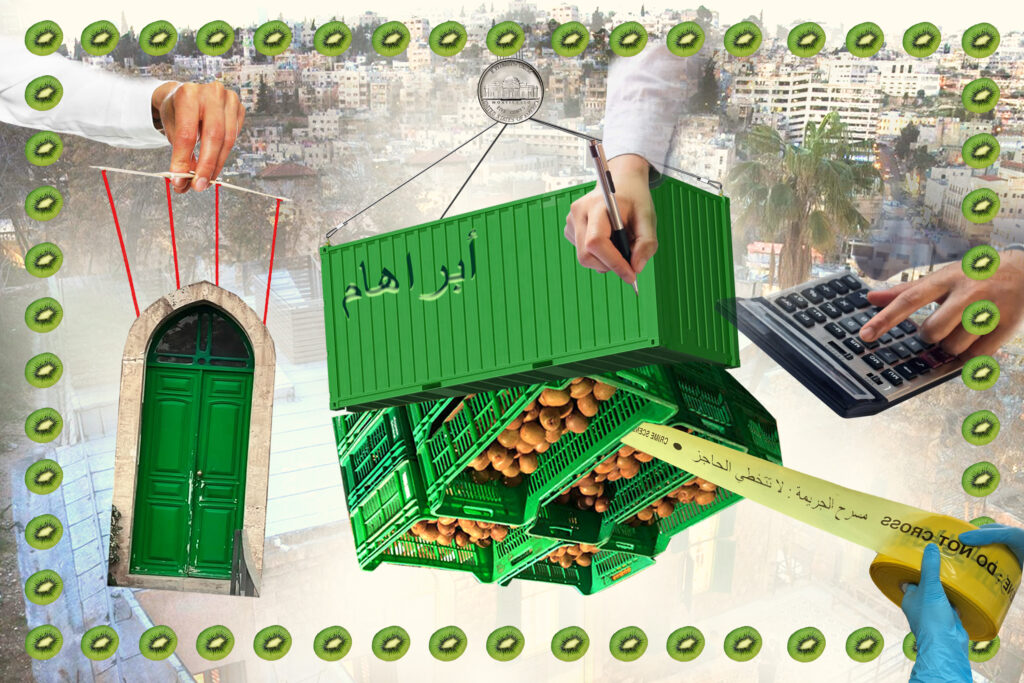
Artwork by Omar
As for her continued presence in the space despite boycott calls, she believes that in contrast to this artificiality, a natural and necessary inclination develops toward “simple” and working-class people who possess an authentic, unmediated understanding of reality. Being with them and observing their labor-intensive work brings a sense of calm and coherence.
I also met the institution’s program coordinator, who confirmed that the institution’s management enjoys a degree of autonomy resulting from ongoing negotiations with the family, without direct interference in programming. Despite a reduced budget of around 24,000 Jordanian dinars annually, the team has developed self-funding mechanisms to sustain its programs. Today, the foundation operates through three fully funded artistic residencies supported by production grants, presented as a form of “social responsibility.”
The coordinator acknowledges the contradiction of receiving funding from a family with problematic affiliations, but argues that redirecting these resources toward Arab artists is a priority, especially amid the withdrawal of the state and the dominance of conditional Western funding. After October 7, the foundation shifted toward cultural support for Palestine, which exposed it to accusations of “artwashing.” He argues that the backlash targeted the foundation instead of pressuring the family, creating a fracture in the cultural scene.
Further, he holds the Union of Cultural and Artistic Workers responsible for the escalation, stressing the need to protect cultural spaces, not destroy them, and to put pressure on funders, not artists. He adds that this crisis reflects a broader dysfunction in the Jordanian cultural environment, where artists are trapped between conditional Western funding and local patrons, amid the absence of meaningful state support.
Ethics of Art and Resistance
I spoke with Salim*, a Jordanian artist and activist who requested anonymity due to threats from the institution’s owning family as a result of his calls to boycott it. He told me that culture and art are not a luxury for him, but highly sensitive fields, where extra caution is needed because any leniency is interpreted as hypocrisy and a deliberate distortion of the concept of “resistant art.”
According to Salim, the Jordanian cultural and artistic scene reveals a deep crisis that goes beyond differences in opinion and reaches the core of intellectual and political integrity. A central question emerges about the value of what is called “working from within” institutions tied to power or bearing names of ruling families. Any attempt to generate dissent from within such structures becomes, in his view, a contribution, possibly even something more dangerous, to legitimizing existing policies and beautifying their image, including normalization policies.
He elaborates that a foundation literally bearing the family’s name, and subject to its direct control over funding, hiring, visits, and strategic decisions, cannot be separated from that family’s publicity agenda. Claiming independence within such a structure becomes an empty argument. The foundation is only allowed to operate within certain limits, ultimately becoming a tool for “whitewashing reputation” and showing authority as a patron and savior of the arts.
He adds that diluting the struggle is not accidental; it is a strategy employed by opponents globally and occupiers who seek to strip art of its revolutionary content. This happens with the help of “intellectuals” and theorists from privileged classes or expatriates disconnected from working-class realities. These actors, intentionally or unintentionally, contribute to a cultural farce that disregards people’s real struggles and elevates abstract discourse over grounded action, which is why a firm stance becomes necessary.
At a time when massacres are being committed, boycott should no longer be a debatable question, al-Khatib argues. Rather, it should be an automatic response showing our rejection of the occupation and its tools, regardless of the psychological warfare waged by some institutions acting as self-appointed guardians of boycotting peoples.
Suhad criticizes the philosophy underpinning major cultural institutions, describing it as a “white man’s philosophy” imposed on our societies, even when administered by people from within them. These institutions attempt to transform cultural work from a collective, accumulative practice into an individual act entirely dependent on funding. As a result, the artist becomes a “manufacturer” of art bound to funder-driven standards; art that cannot free itself from questionable funding constraints lacks creativity because the funder already determines the idea and outcome in advance. Alternative experiments and cooperatives, however, have shown that collective will can produce genuine art without dependency on such institutions.
As for the Union’s statement, al-Khatib sees it as a necessary step towards breaking the deafening silence reigning the culture scene at a time of massacres and starvation war. Though the reactions to the statement varied from questioning the funder’s ties with the occupation to targeting those who published the statement with personal attacks, the truth remains clear in the absence of any official response from the financing company.
Conclusion
On 13 August 2025, several artists and cultural workers connected with the foundation sent a message to the owning company – of which I received a copy – where they expressed their concern for its future and role in the art and culture scene. The signatories stressed their outright rejection of any form of normalization with the Israeli occupation for it legitimizes the genocide and starvation in Gaza, as well as the annexation, forced displacement, and systematic violations against the Palestinians. They warned that linking the foundation’s funding to the family could expose the foundation to dire criticism, despite its commitment since its founding to critical artistic discourse and epistemological liberation.
Further, the signatories indicated that the recent boycott campaigns have caused direct harm to the artists and workers associated with the foundation and may damage their careers by being stigmatized as normalizers with the occupation. They asked the family for an official, public and transparent clarification regarding the circulating information to preserve the foundation’s reputation as a local cultural foundation and enable people and artists to take a position based on clear facts.
The head of the family and owner of the foundation responded – of which I also received a copy – stating that the institution’s funding is based on family investments within Jordan and is not directly or indirectly connected to any external political or economic entities. He emphasized that none of the family’s private companies work with Israel “in any way or form,” reaffirming his commitment to justice for Palestinians and rejection of all human rights violations and forms of normalization that legitimize crimes against the Palestinian people.
He added that the foundation has functioned since its establishment as an independent cultural space, free from family interference in its programming or institutional direction, and is led by artists and cultural workers from the region. He also expressed his understanding of concerns about the impact of circulating accusations on the foundation, its workers, and the wider cultural scene, and announced his openness to dialogue, reaffirming his commitment to transparency and to protecting the foundation as an independent cultural space.
Yet, neither the foundation nor the family has issued an official statement to date.