
This issue is anchored in a difficult but urgent question: What role can art play in a world where entire peoples are being erased, cities reduced to rubble, and human lives flattened into passing images on our screens? Looking across the Middle East and other regions shaped by colonial violence, we approach art as a meeting point between memory and embodiment, politics and spirit; a space where creation emerges not despite loss, but through a reckoning with it.
Throughout the issue, we examine how artistic practices are forged amid siege, displacement, and environmental devastation, and how such conditions reshape our understanding of creativity itself. From family archives that preserve fragile histories to artists rethinking the legacy of politically engaged music; from attempts to chart fractured histories to images that struggle to contain the reality of a homeland under attack, we ask what endures, what disappears, and what can still be imagined. Art, in this context, also becomes a spiritual act: a way of calling upon the dead, remembering those who have been lost, and returning to places that now survive only in memory and dreams.
Sometimes, refusal is the most meaningful artistic gesture. In these pages, we encounter artists who have chosen to break with the long-standing relationship between art and the institutions that seek to contain it. When Iranian artist Parham Ghalamdar set fire to his own works in an open field in northern England, the act was not one of destruction but of return to a fundamental question: who is art for, and what remains when art no longer feels sufficient?
This issue also considers how art operates within broader struggles for justice. How do artists participate in liberation movements, challenge structures of power, and resist attempts to silence or absorb them through censorship, institutionalization, and cultural whitewashing? Against a system that continually seeks to neutralize art’s political force, we look toward collective, experimental, and marginal practices that use art to dissent.
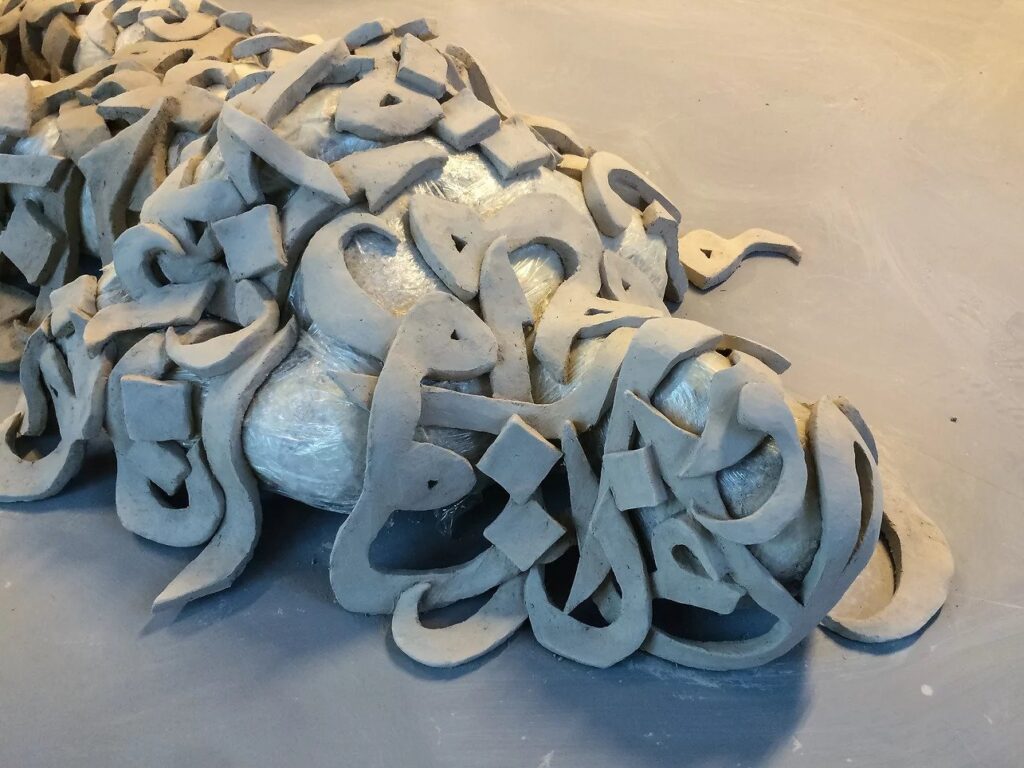
Artwork: Sculpture ‘What Lasts! (Grave)’ by Ahmed Umar, 2016.
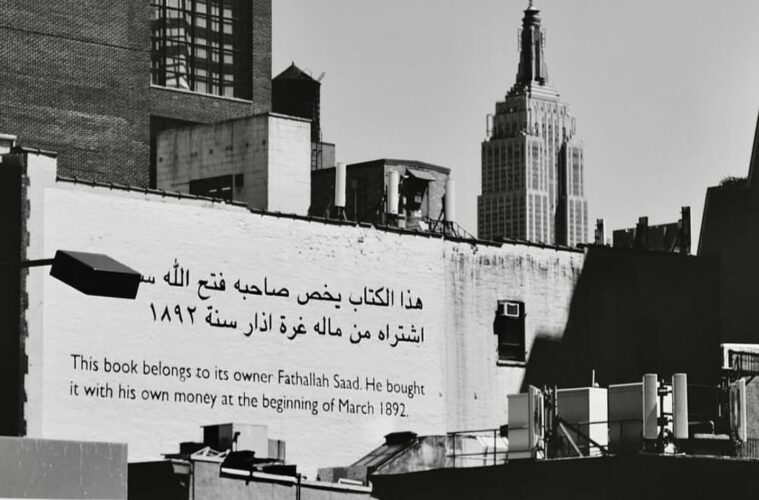
Featured image: ‘Fathallah Saad’ – Ex Libris by Emily Jacir, 2014.
We also turn our attention to identities that exist beyond fixed categories and national borders. Returning to Hormuz, not as a strategic passageway but as a living world shaped by sailors, migrants, and queer communities, we explore ways of belonging that move with tides and winds rather than maps. What becomes possible when identity follows routes of movement instead of lines of division?
Elsewhere, on stages in Berlin and beyond, queerness and Arabness appear not as opposing forces to be reconciled, but as cultural realities to be celebrated. Performance emerges as a form of memory, care, and resistance.
Along Africa’s margins, we trace how visual culture reveals the shifting contours of social violence from early Nollywood cinema to contemporary policies that continue to fracture communities. What unfolds at the margins often offers a glimpse of futures already taking shape.
The issue is accompanied by a carefully selected group of cover subjects, chosen by our team. Though their stories differ, they are connected by the themes running through these pages. Some continue to navigate the realities of war and repression; others deploy their artistic practices against forces that seek to erase them. Together, they remind us that art has never been merely decorative. It is a way of taking a position in the world.
Ultimately, this is an issue about gesture(s) the body expresses before language can fully articulate it. The Fields of gestures issue is not quiet or passive. It is where movements begin, where meaning takes shape, and where new possibilities emerge.
From point zero to digital debris, margins are porous.1 We invite the readers to move through these works and see what emerges from confrontation, annihilation, and agency. Working with these artists and writers, I see an errant path amidst oppression and genocide.2 Across their works, they bring to the front what much of our governments repress: anger and refusal. This insurgence aligns with their choice to imagine otherwise.3 And much of this resistance starts in intimate enclosures with oppression: patriarchy and capitalism.
Dear reader, these texts offer the margins as a site of power. And due to them being porous, such work spills towards the frontlines. Either by offering new tools, slogans, actions, provocation, anger, confrontation – or if they must die, to at least tell their story.4
We’ve asked what is good of art in the midst of genocide and Israel’s invasion of Lebanon, Syria, and the bombing of Iran and Yemen. But perhaps – and I offer this gently – we are looking at art through a Western lens. Does art need to have value? Who assigns it? And how is it assigned?
If we do not write or create – who will? And at what cost? For to create, think, and capture, we need to collaborate and be in connection [to something; to anything]. And if we do not do that for ourselves, we lose a critical weapon in our errant path: our voice, our history, our connections. Perhaps it is exactly that, that the margins offer: alternative forms of life are already being practiced there.