Words by Diala Lteif
Creative Direction by Mohamad Abdouni
Photography by Mohamad Abdouni
Creative Assistance by Mohamad Yassine
Hair by Remah Jammoul
Makeup by Alexandre Paulikevitch
This feature is part of the “Fields of Gestures” issue
Alehom! A simple interjection that Alexandre Paulikevitch has come to be known for. Alehom! as in, he will perform his show despite threats from extremist groups. Alehom! as in, let us confront the security forces attempting to squash a protest. Or simply: Alehom! as in, let’s dance, just to be.
Alexandre Paulikevitch is, without a doubt, one of the most influential Baladi dancers of our time. His twenty-three-year career as a dancer and choreographer has been equally shaped by artistic talent and political commitment. Born and raised in Lebanon, Paulikevitch began his career in France before returning to his home country, where he remains today. A trailblazer in every sense of the word, Alex — as friends have come to know him — has opened a path for many others to follow. An acclaimed artist who has performed internationally, he is the first dancer to represent the Baladi form at major international festivals, including the Festival d’Avignon and a 24-hour performance at the 36ª Bienal de São Paulo earlier this year. His approach to the art form is perhaps best captured in his choice of terminology: Baladi dance, as opposed to the more common designations of belly dance or oriental dance, both of which Alex firmly rejects as colonial heritage. This male queer artist defiantly confronts gender norms, reclaiming space for male dancers within this universe, while grounding his entire practice in a decolonial ethos. The dance must be restored to its original name, the one Egyptians themselves gave it: Baladi, the dance of my country. Everything Alex does is, at its core, a reclamation of this art form, at once artistic and political.
Today, I would like to introduce you to Alex through my eyes. I still remember vividly the first time I walked into his dance class in the summer of 2013, instantly struck by his presence. He carries the strong charisma of an artist you simultaneously love and respect, a rare and powerful combination in a teacher. Over the past thirteen years, I have had the immense privilege of growing not only as his student, but also as his friend, his comrade in protest, and above all, his devoted fan. From this position of closeness, I have witnessed many facets of Alex, but perhaps the greatest lesson he has imparted is through his approach itself. To Alex, Baladi dance is his terrain of praxis: a bridge between theory and practice. When I asked him how he sustains this practice in the face of violence and erasure, his answer was characteristic in its simplicity: Confront them, he told me, they are often shocked when you stand your ground. In what follows, I attempt to unpack his artistic practice and illuminate his method, one I believe will resonate deeply with anyone seeking to resist oppression within their own field. In a time when so many across the Arab world are gripped by despair and helplessness, I invite you to read this as the Paulikevitch method of resistance through confrontation.
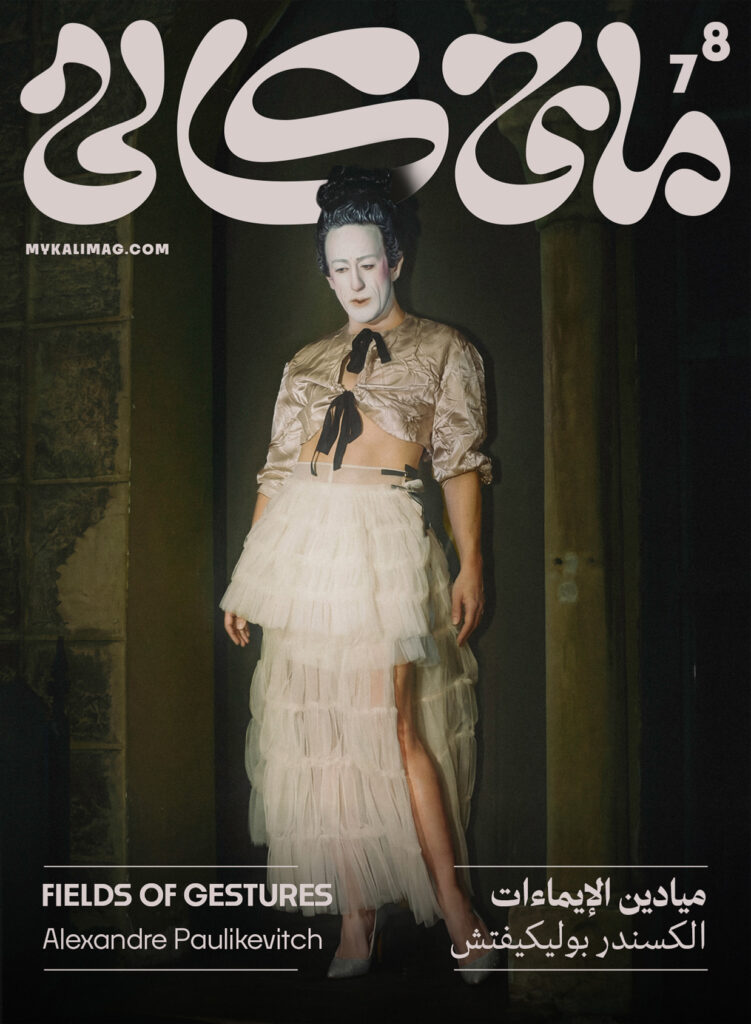
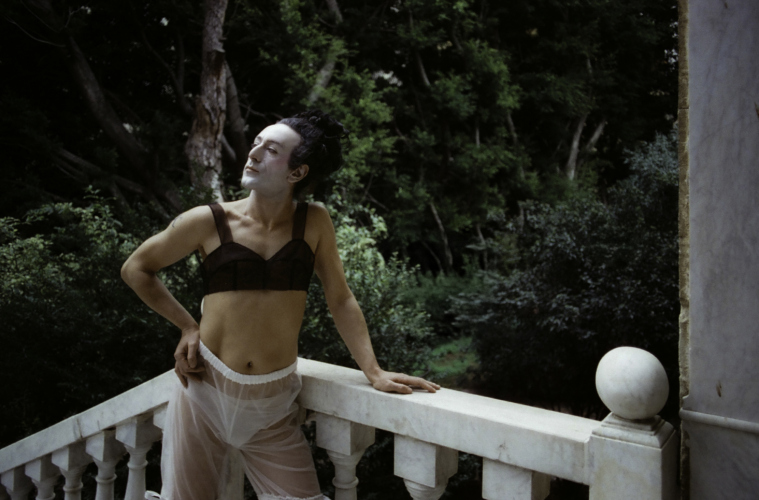
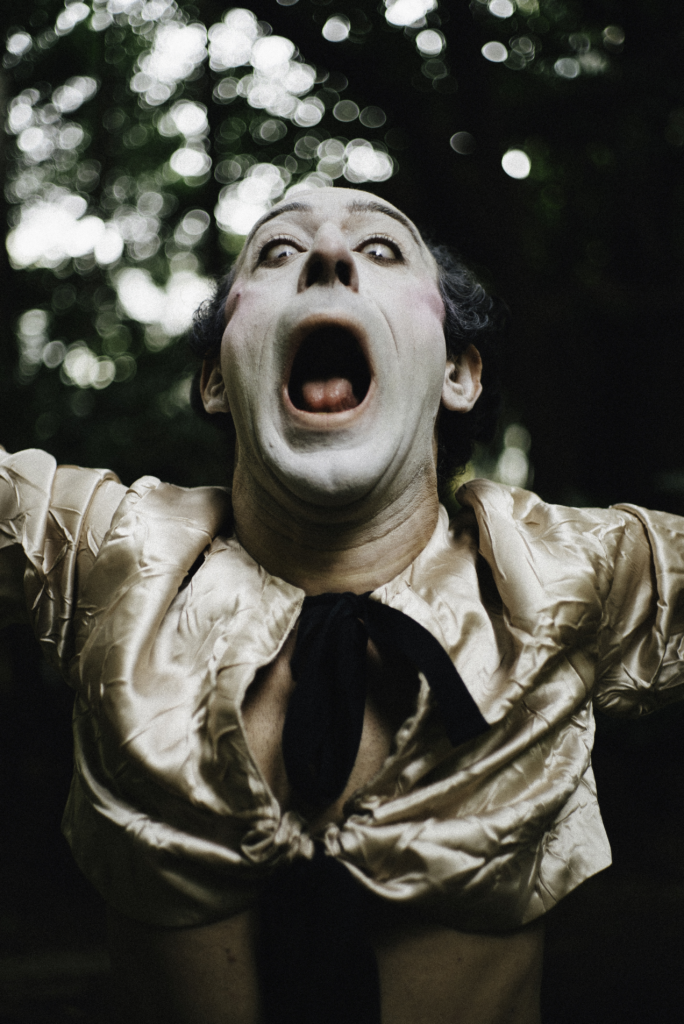
Before we turn to my conversation with Alex, I would like to share a brief note on the photographs by the talented Mohamad Abdouni that accompany this piece. Shot inside a Beiruti home, the images draw on an aesthetic that fuses French Rococo with Japanese Butō, where neither choice is incidental. In reclaiming the Rococo aesthetic, the two artists remind us that the French were themselves inspired by Arab culture at the time of its emergence. Adorned in stark white make-up, Alex stands defiantly, reclaiming this aesthetic on its own terms. The Butō influence, meanwhile, speaks to the tension between life and death. To paraphrase Alex: nothing emerging from our region in a time of genocide and war can escape a ghostly shade. In the depths of winter, Alex finds both beauty and resistance in death itself. Alehom!
Let’s start from the very beginning. Tell me about where you grew up and how everything led to dance.
I grew up amid the atmosphere of the [Lebanese Civil] War and the [underground] shelters where people sought refuge. Unfortunately, war plays a major role in shaping people’s lives in Lebanon. In the late 1980s and early 1990s, there was no internet or anything like it, but the images of dance were incredibly captivating to me as a child. I was fascinated by dancers such as Hwaida El Hashem and Dany Bustros, especially by their glittering costumes, which were the first thing to catch my attention. Then Dina appeared on the scene, and there was a kind of visual shock, so to speak. The images of these dancers and the scenes I watched became imprinted in my mind.
During the Civil War, it was, of course, impossible to enroll in dance classes. Moreover, our cultures allow boys to dance only up to a certain age, perhaps until age 5. After that, they are expected to grow up and become men, and they begin to be taught the things that are supposed to make them men. So I danced when I was a very young child. I remember the restaurant Nahr al-Funun, owned by Simon Asmar, where an oriental dance festival was held. We would watch the festival on television, and I would dance, and my family would delight in seeing me dance.
But I also remember that my mother bought two dressing gowns, one pink and one green. My sister took the pink one and I took the green. I would run around the house with it billowing behind me. My father did not like that because he did not want his son to become a woman. And so I suppressed my desire to dance.
That is why I speak about images and visual elements when discussing dance. I was prevented from dancing at a very young age because of the repression exercised by the ‘Eastern man’ and because of toxic masculinity. My desires were suppressed, and I also learned to suppress them myself. But the images of the dancers remained imprinted in my mind.
Later on, when did you really decide to dance?
Around 2003, I was about twenty-one or perhaps twenty-two years old—already considered a late age to begin dancing.
Still, my adolescence carried a spirit of defiance. We used to dance at parties and similar gatherings. There was a place we would go to dance, though I can’t remember its name now. Of course, we didn’t really know how to dance, but we believed we danced better than women. I myself thought I was a good dancer and had no need to take any classes. We would go as a group and dance together, and everyone in the group was gay, although some insisted on denying their sexuality! In any case, I don’t see that period as a conscious decision to dance; I was still an adolescent. It expressed a certain desire within me, but it was not yet a deliberate choice.
There was an urge, an impulse to assert my presence, even without knowing how to dance. I was creating a space for myself and claiming my place in the world. It was about affirming my existence and my sense of self. We live in a society that rejects everything and insists that the problem lies within you. If you are gay, even from a religious perspective, people tell you that God hates you, that you are deviant, that you deserve to be burned, and so on. Everyone [the family, the school, society as a whole] tells you that the problem is you until you eventually reach a point where you reject all of that and declare your existence.
A person has to cultivate that spirit of resistance within themselves; otherwise, they risk losing who they are. Confrontation is not easy, and not everyone is capable of it. It is harsh. But the way I was raised taught me not to be afraid. My parents also gave me strength by teaching me to express what I believe is right and what I truly believe, even if my convictions change later. What matters is that, as long as I am convinced that I am doing nothing wrong and harming no one, I should not be afraid.
That upbringing gave me the ability to confront society and the resilience to withstand its judgments. Society may think we are deviant or sick; it doesn’t matter. This is our reality, and their opinion is ultimately irrelevant. That is why, during my adolescence, dancing became a way of asserting my existence.
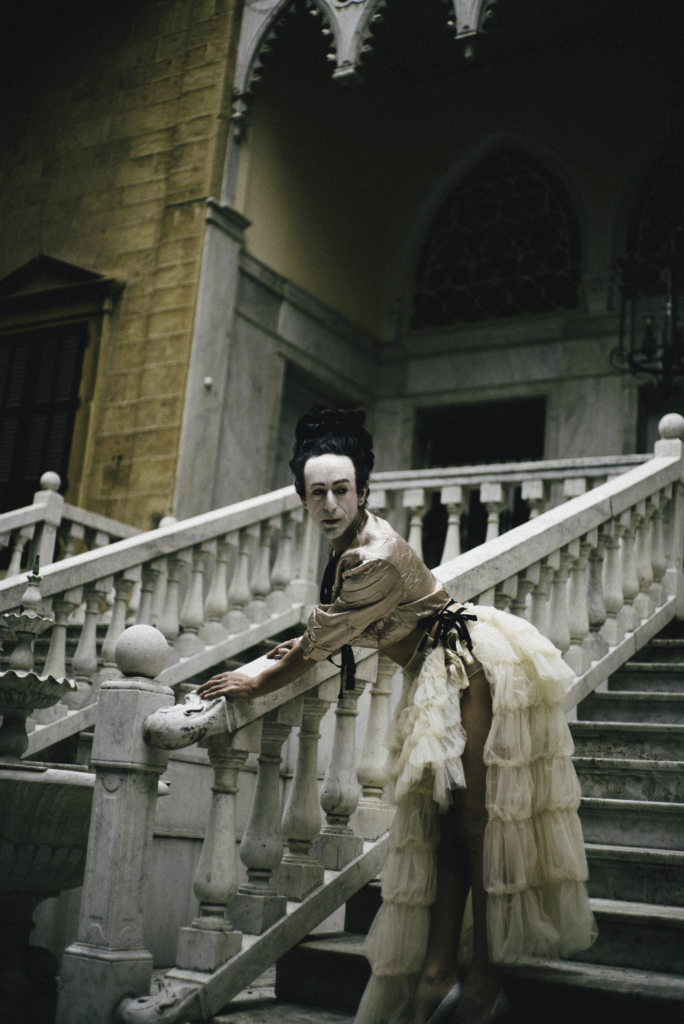
Top, Skirt; Renaissance Renaisssance. Photographed by Mohamad Abdouni. Hair by Remah Jammoul. Makeup by Alexandre Paulikevitch.
You grew up in a conservative right-wing milieu, so how did your Christian background and upbringing influence your political awareness? How did you become the leftist activist you are today?
There has to be a revolt against one’s circumstances and against oneself. Otherwise, we cannot accomplish anything meaningful. If we simply conform to our environment, we cannot grow. So, to develop, I had to rebel against everything I had learned from my family. I rebelled against everything I had seen and lived through so that I could develop my leftist political consciousness.
I studied hospitality, then theatre and dance at L’université Paris-VIII-Vincennes-Saint-Denis (University of Vincennes in Saint-Denis, Paris VIII, or Paris 8), which was established in the wake of May 1968 and where Gilles Deleuze taught philosophy. Through that environment, I learned a great deal. Gradually, leftist thought began to permeate my worldview.
Michel Foucault’s Surveiller et Punir (Discipline and Punish) had a great influence on me. Foucault reexamines power and how it was concentrated in the body of authority. It tackles how the police and prison emerged and how power developed from psychiatric hospitals to intelligence agencies. Now, we can consider power in the light of social media, artificial intelligence and biopolitics. We saw what happened during COVID-19, how people were controlled and how this control changed and evolved. I even reconsidered the concept of motherhood, what motherhood is, the ideas we learn as we grow up to see as some sort of divine revelation and maternal instinct. In L’Amour en plus (Mother Love: Myth and Reality), Elizabeth Badinter argues that there is no such thing as maternal instinct and that it is only a social and political construct. I pondered what this meant. In short, I have read many books that influenced me and changed my way of thinking.
There is also something about the French that I admire greatly: their revolutionary spirit. Of course, their revolution was not perfect; it had disastrous consequences. Yet there is one historical experience that fascinates me in particular. A chapter of Parisian history that many seem determined to erase: the Paris Commune.
The most striking feature about it was gender equality. Louise Michel and Arthur Rimbaud were among its key participants. Later on, I learned that Rimbaud and poet Paul Verlaine were lovers. I studied Verlaine at university but I had no idea that he was gay or that his poems were addressed to Rimbaud. So, I gained more knowledge and opened up to the world. I learned many things from this spirit of revolution, which meant a lot to me.
How did this ideological and political openness manifest itself in your dance?
I will tell you a story that can show how leftist thought influenced me. It’s about a question that a teacher once asked me. I quit studying law and joined dance classes. She asked me about the type of dance I was practicing, and I said Oriental dance. She looked at me and asked, “Oriental to whom? Think about it.” Ten years later, I was at an event and saw her among the audience, so I addressed her and said, “Today, we have among us someone I would like to thank, Professor Isabelle Launay. I would like to tell her that I now call it ‘baladi dance’ not ‘oriental dance.’ She helped me realize that we are only considered ‘Eastern’ in relation to Europe, which has historically positioned itself as the center of the world and taken it upon itself to classify the rest of us as the Near East, the Middle East, or the Far East.” My entire thought was shaped by French universities, where critical self-reflection is deeply embedded in academic culture. The French are often willing to direct criticism at themselves and their own history. In fact, it was a French woman who first introduced me to postcolonial thought. Before that, I had no awareness of it at all.
You returned to Lebanon after the 2006 War. Why did you decide to return? And what happened to your dance career?
People were leaving Lebanon, but I decided to return. My mother had cancer and was dying. I left everything behind and returned home to be with her. I stopped dancing until my mother passed away because my priority was to stay with her and take care of her.
I also wanted to explore the South and see what Israel has done there. I didn’t know it very well. At that time, the Samidoun movement had emerged, and I had friends who worked in the UN and had homes in Tyre. Every weekend we went there and explored the entire South. What I saw in Bint Jbeil shocked me; the destruction was immense. I wanted to investigate what kind of stories dance can tell. While researching how to develop dance, I was thinking about whether dance could tell stories of grief, war, and death, or whether it was just about seduction.
It was 2006, and I reflected on deconstructing the concept of dance. This gave birth, in 2009, to my show Mouhawala Oula (Arabic: محاولة أولى). This was how the deconstruction of baladi dance began, rather than oriental dance, for I hadn’t used the former term at the time. One night, I was at the Barometre Pub in Beirut when the song “Shik Shak Shok” started playing. I paid attention to the lyrics: “Shik Shak Shok. Shik Shak Shok. Darling, forget about rap and rock and let’s dance baladi. Lovely!” I realized that many singers like Adaweyah, Najwa Karam and Ramy Ayach use “raqs baladi” (baladi dance) and not “raqs sharqi” (oriental dance) in their songs. In our language, there is no such thing as raqs sharqi; it’s raqs baladi.
From that point on, I began deconstructing everything: the name itself, the discourse surrounding the dance, and the dance form as a whole. The years between 2006 and 2009 were a period of intensive research into these questions and concepts.
Let’s talk about men and dancing; you are not the first male dancer.
Traditionally, men have acted as dance instructors. Arab men dance but within limits, except in Morocco; they have a different culture. You can see male dancers perform in Jemaa el-Fnaa Square in Marrakesh. They are from the Amazigh communities. In Egypt, men dance in Shaabi (popular) weddings. They see no issue with it, as long as one does not take it up as a profession. Men dance in jalabiyas, and there is no problem with that. As long as you don’t transgress the bounds of decorum or propriety, say by wearing sequins, society will let you dance.
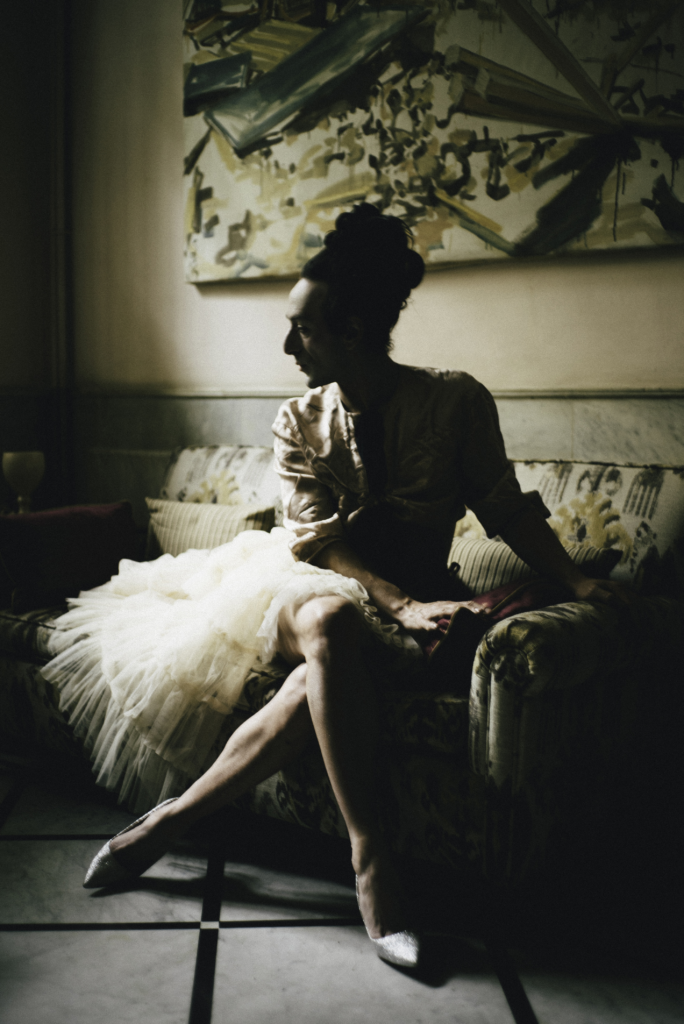
If we were to live in society and among people, we should appear as we are and get them used to how we look, appear, and exist.
Top, Skirt; Renaissance Renaisssance. Photographed by Mohamad Abdouni. Hair by Remah Jammoul. Makeup by Alexandre Paulikevitch.
Not a single male dancer in the Arabic-speaking region has dared to put his picture on a poster advertising a dance performance of his. I did it. Tito and other male dancers perform to foreigners in five-star hotels as part of closed, unannounced events and train dancers abroad. But this is not enough, because no one in their own societies knows them or even knows they exist unless one of their videos leaks, and then they are met with insults..
What about Lebanese male dancers? Mousbah for example.
If it were not for Mousbah, I would not have danced or gained fame. He paved the way for the dancers who came after him. Alec Khalaf was another great male dancer who began his dance career in the 1960s at the Chansonniers theatre, collaborating with Yvette Sursock, before Andre Jadaa or Pierre Chammassian did. Khalaf was an actor first and dancer second. Mousbah taught dance to graduates at the American University in Beirut (AUB). He was a signature fixture at Michel Elefteriades’ MusicHall.
I was constantly obsessed with being respected. Thus, I didn’t want to build a career dancing in pubs and bars like other male dancers, and I always wondered how I could command this respect. Classical dancers looked down on me, and I wanted to find a way to change people’s view of baladi dance. I couldn’t yet figure it out; all I knew was that I wanted to add a new page to the history of baladi dance. This is exactly what I did. I have now also paved the way for other male dancers, like Ahmad Khansa, to emerge.
I have always wondered: who was responsible for the lack of respect for this type of dance? Dancers? Society? Was there something wrong with baladi dance? Was it the dance venues? In restaurants, for example, no one pays attention to dancers; all people care about is eating, drinking and talking. So I started thinking about how we can re-present ourselves as dancers and what that responsibility specifically is, and I am still exploring how to do that.
Tell us about your first show, Mouhawala Oula.
It was an attempt to transition Baladi dance from cabaret/nightclub to theatre, in this case the Theatre Tournesol. At first, I wanted to highlight movement. On stage, there was a white skirt, headphones, and a bottle of water. I put on the skirt and headphones, played the music and started to dance alone. I wanted the audience to see my moves without hearing the music that I was dancing to.
On stage with me was Stéphane Rive on soprano saxophone, and Kara Lynch was filming the video. I was dancing while my facial expressions were captured and projected live onto the screen. Stéphane was playing in the background. I wanted to separate folk dance from Arabic music. Then the music intensified, the camera focused on my face, and places or houses in Beirut that were on the verge of disappearing appeared, while my ghost appeared on the screen over the video. There were overlapping scenes in multiple layers.
My mother had died, and I wanted to drive away evil spirits, so I moved through three bodily states: wearing a large red skirt, I shifted into a male form, then a female one, then Japanese Butoh. Scene upon scene unfolded over the sound of the saxophone. There was astonishment and confusion from the audience, but the performance continued in slow motion until it proved that, in the end, what matters is movement, not the body.
So, Mouhawala Oula was an attempt to offer something new and to answer this question: What would happen if we stepped outside the boundaries of traditional dance?
How does politics manifest in your work? For example, the disappearing spaces we saw in Mouhawala Oula. When did you decide to combine politics with art?
It all started when I decided to stop using the term “oriental dance” and adopted “baladi dance.” It was a political decision because the former was a colonial one. Contemporary dance is not interested in feelings or emotions; it leans more into logic. In the West, people care more about logic than feelings and emotions. I’m an emotional person, so I focus on feelings. That too is a political decision because doing something you love, going against the grain, is also a political act.
Everything in dance is personal for me. I am honest with myself before being honest with the audience. My second performance, Tajwal (Arabic: تجوال), was extremely personal; I spent almost a year and a half recording the insults and curses I received while walking in the street. In this way, my daily life becomes part of my work. I do not separate my life from my practice; everything in my life can become a source of inspiration for my work. My life and my work are inseparable, and each feeds the other.
When did you start your political activism?
I never stopped. My activism did not start in 2006. It did in France with the demonstrations and sit-ins I participated in. I went to France in 2000, and the Iraq War started in 2003. I participated in demonstrations with colleagues from several countries including Chile, Mexico, and Brazil. Latin Americans fully understand the essence of anti-Americanism; they understand what colonialism means. It was from them that I understood and learned what colonialism is.
In Lebanon, I participate in demonstrations when I feel that enough is enough. I remember the first time I demonstrated when I returned to Lebanon. It was in 2006 or 2007 for an Ethiopian worker who threw herself off a balcony because she was raped. There were only three of us at this demonstration and we lit candles for her.
I also participated in a demonstration when two young men were beaten in Sassine Square because they were gay. This was in 2008, and it was the first demonstration for gay rights in the country’s history. We were outnumbered by the police. Generally, I participate in demonstrations when I feel that it’s enough, enough injustice and enough hypocrisy, when I see that what is happening is unfair and that no one wants to change anything.
I feel that I am in the same struggle with immigrant workers, abused women, domestic violence victims, children with disabilities, and orphans, because of my queerness. But it is not what motivates me to demonstrate. My principles do. It is different of course when it is a demonstration for gay rights, as was the case with the demonstrations protesting the forced anal examinations performed at Hbeish Police Station. I stood in front of Al Madina Theatre and held a sign that said, “ I am gay.” Confrontation is something I do constantly. I don’t recall a specific time when I decided to confront. Confrontation is nothing new to me; I do it all the time.
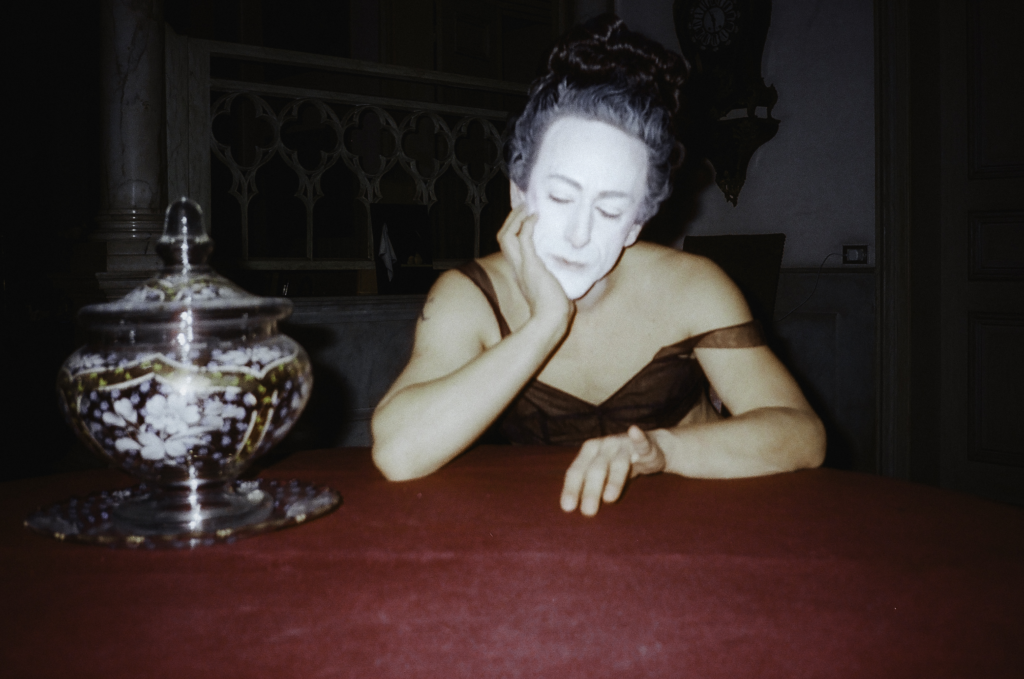
Bra; Renaissance Renaisssance. Photographed by Mohamad Abdouni. Hair by Remah Jammoul. Makeup by Alexandre Paulikevitch.
Tells us about your role in organizing the Laique Pride, a significant phase in the history of popular demonstrations against sectarianism in Lebanon.
The year 2010 witnessed a series of shocking incidents. A group of students at the Lebanese University were prevented from playing Fairouz songs on religious grounds; I think it was the Day of Ashura or something. Excerpts from Anne Frank’s diary were removed from a school textbook following a campaign by Hezbollah. A rock festival was supposed to be held at the Forum de Beyrouth, but the head of Lebanon’s Catholic Media Center urged the Jesuits to send text messages to the parents of students who were attending the festival to prevent their children from going to the event because it promoted Satanism.
The first two incidents were shocking to me, but following the third one, I decided to post about it on Facebook. I wrote, “Extremism has no religion and now it’s time for the Christians to listen.” A friend of mine, Said Shaitou, who was in Paris at the time, wrote a comment that said, “Let’s organize a Laique Pride.” He was joking. I played a long with it and said that it was a great idea. So, we created an event using a fattoush image as a cover. We were joking and laughing then Yalda Younes joined us and said that she wanted to be part of the event too. So did Kinda Hassan and Nasri Sayegh. We laughed and shared ideas and that was it.
The next morning, we found out that 3,000 people wanted to attend the event and that 15,000 were interested in attending. It was no longer a joke because Yalda, Nasri and Saeed were in France, and only Kinda and I were in Lebanon. It was amazing that we contemplated holding the event. Eventually, we decided to do it.
This is how the first event came to be. It really shook activism in Lebanon to such an extent that it took the leftists by surprise. You know how leftists in Lebanon see themselves as the vanguard and protectors of activism in the country. We brought together artists and promoted the event in a new and clever way. We turned our childhood songs into political ones. There was this popular song from a Rayovac commercial that we changed its lyrics to mock sectarianism. So what was “What’s your battery?” became “What’s your sect?” We played on many things that brought together people from different backgrounds, from the Christian right to the communist left, and it was amazing for everyone present.
Then there were the anti-sectarian demonstrations, the tol3et re7etkom (Arabic: طلعت ريحتكم) “You Stink” protests of 2015 and the 2019 Revolution. These protests and demonstrations cannot be separated; they are accumulative. We had many collaborations with KAFA and held the largest demonstrations in the history of the feminist struggle for women’s rights in Lebanon. Once they asked me to dance at one of the demonstrations. We were mocked and attacked by Marcel Ghanem and the Salafists. So we decided to film the dance in collaboration with Nada Abou Farhat in a video entitled Rah Qum, Rah Irqus “I will get up, I will dance” (Arabic: رح قوم، رح أرقص). We performed it everywhere. I took dance to the streets to demand the rights that only a few would think to fight for.
What about the attacks you faced as an artist, how you confronted it and the resulting controversy?
My shows create a buzz, at least the ones that go viral, but this does not happen with all my shows. They can also be controversial and lead to some kind of debate, and what matters is the debate not the attack. This controversy is not intentional for I have no control over it. The press covered my shows and published articles about my art and me. When I performed my Baladi ya Wad (Arabic: بلدي يا واد) show, for example, LBC aired a report that attacked me. This debate contributes to the development of society, not the attacks I face, which are of no consequence to me. What matters is the difference I make through my art.
When I post a video on Instagram and it goes viral, I face attacks and receive a lot of insults and abuse. But I do not remain silent in the face of these insults. I always talk back. I don’t like paying much attention to the attacks because it means that I am a victim, and I never see myself as a victim. Instead, I focus on how I respond to it.
One of the videos that brought me the most insults was a clip from an episode of the Lebanese talk show Ahla Nas (Arabic: أحلى ناس) broadcast on Al Jadeed TV, where I appeared as a surprise guest to perform a Baladi dance in front of Dina. I didn’t reply to any comments because they were too many. The number of views reached 11 million. But I replied with a video when Dina said that I disgusted her. In the video, I said she had the biggest influence on me and that I loved her so much. Even if she was disgusted by me, I still loved her. One must approach these matters prudently and not think of himself or herself as a victim. These confrontations are extremely important because they contribute to the development of society. It is essential to open space for others to develop a more open perspective and mindset toward their societies, because this possibility is not available to everyone. And through confrontation, political consciousness is created.
Everyone sees that not responding to attacks helps spread the content because of how algorithms work. When you do not respond to bullies, their attacks increase and the content spreads as the comments increase. I respond though, but not with hostile words but with content and photos. That way the content spreads while I put bullies in their place.
Anyway, none of this matters. What matters is the confrontation and its impact, as with the LBC segment. But what matters is what happens when a work provokes people, and what follows that provocation and not the provocation itself.
You have locked horns with the Lebanese State too during the 2019 Revolution. What happened?
In 2019, during the revolution, I was subjected to arbitrary detention. It was somewhat harsh because I was beaten. When you are arrested, you are beaten. I had just arrived and had done nothing; I did not even understand what was happening. They arrested me and placed me in a car to transfer me somewhere, but I noticed they were afraid because the revolutionaries had blocked the roads. I realized, through the reaction of the security forces, that we were a major force on the ground and that what we were doing had a huge impact.
The arrest itself was a significant precedent, because when I arrived at the police station and they asked for my name and profession, I told them I was a dancer. The revolution pushed me to speak openly about my profession. No one would normally dare to tell security forces at the airport, for example, that they are a dancer or work in theatre. I said confidently that I dance, and they asked what it meant. I told them I dance and it does not require explanation. They asked again, completely confused, what they should write under “profession,” and I said: dancer. In the end, they gave in and wrote “dancer.”
The same thing happened in the Military Court. I said that I was a dancer and everyone was utterly surprised. At the police station, they told me that this was a precedent, that no one has ever told them that he worked as a dancer. They had tried to frame me, but I told them that I knew my rights and that I would remain silent until my lawyer arrived. They knew they could not take me lightly. It was one hell of a night. I gave a lecture on dance in the middle of the police station while artists and musicians stood in front of the station and played music. The officers panicked and asked whom I was to have all this fuss caused over me. They changed the way they treated me and asked me once again about my name and profession to gauge how important I was. I told them that I was a dancer. They were baffled by the calls they received about me from numerous ministers and VIPs, and by the support shown by artists, including Nadine Labaki. When I was released, the dancing and tapping of finger cymbals began. This was unprecedented on all levels. When it was time to go to the Military Court, the matter had caused a great stir that influenced them.
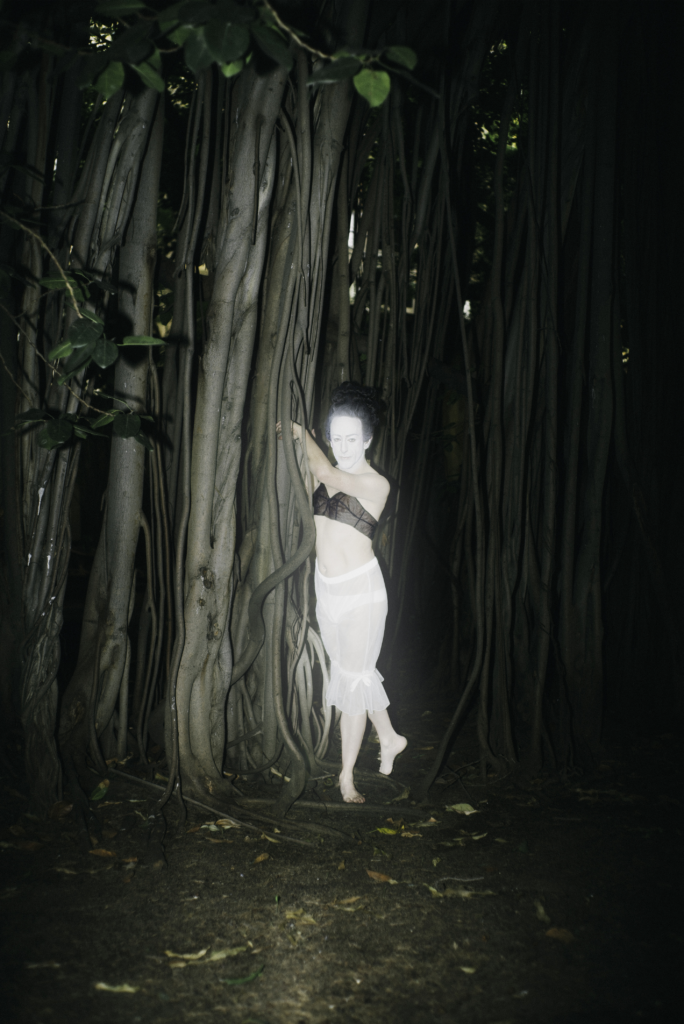
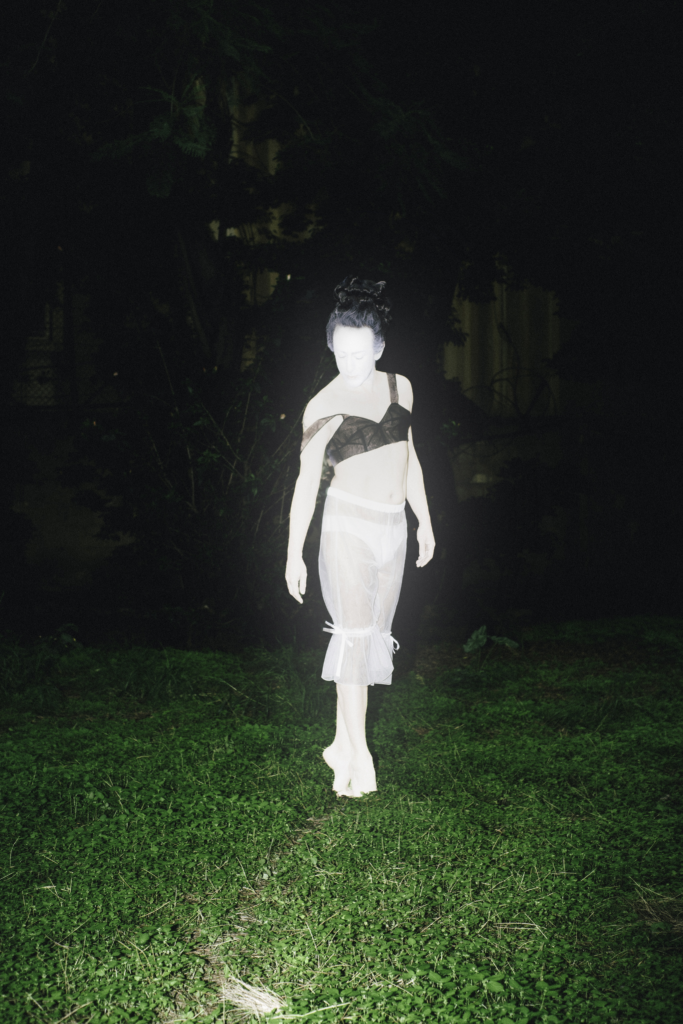
Pants, Bra; Renaissance Renaisssance. Photographed by Mohamad Abdouni. Hair by Remah Jammoul. Makeup by Alexandre Paulikevitch.
In September 2025, the advertisement for “Cabaret Paulikevitch”, one of your latest shows in Metro al-Madina in Beirut, circulated on social media causing quite a stir when the Jnud al-Rabb (Soldiers of God) and Salafists made threats against you and the show. How did you deal with this incident?
Jnud al-Rabb are good for nothing. They are dangerous, but good for nothing too. What was significant about this confrontation with the Salafists and Jnud al-Rabb was that someone actually fought back. Everyone cancelled their shows because of similar threats, from Mashrou’ Leila, stand-up comedians to drag queens. This was the first time someone had announced that he had decided to confront and fight back and that he would not cancel his show. This was a significant shift for us all queer people. Everyone advised me to cancel my show, but I refused to budge. I told them to watch and learn from us veterans. It was important for me to speak publicly to the press, local and international media such as the Associated Press, because we could not hide forever. Their goal was to gain fame; they did not expect any confrontation, but I fought back and they were shocked. I persisted against everyone’s advice and Jnud al-Rabb and Salafists were subsequently dispersed by security forces present.
If we were to live in society and among people, we should appear as we are and get them used to how we look, appear, and exist.
We talked about some key figures such as Taheyya Kariokka and Dany Bustros. Both had their own confrontations at some point or another in their lives, Kariokka through her political activism and Bustros by revolting against class differences. How do you understand your work within this context?
Badia Masabni is my benchmark in my work، she is the grand matriarch. She moved dance from the street to cabarets and I moved it from cabarets and restaurants to theatre. I combined it with contemporary art. She moved it to restaurants and cabarets, and I took it from there to artistic and political theatre, festivals that baladi dance hasn’t reached before, cultural centers and museums. What I did, no one has ever done before.
We have had enough imitation of the West; we already had a great deal of social diversity before gender theories appeared. We should stop diminishing ourselves. We do not need to imitate the West in order to progress; we were already advanced before Western colonialism came and reshaped how we see ourselves, making us perceive ourselves as inferior, which is not true.
Back to dance. Before Judith Butler developed her gender theory, Fifi Abdou confronted accusations of promoting obscenity by wearing a jalabiya and using a Tahtib (fighting stick) stick, a form of martial art since ancient Egyptians. Abdou challenged gender norms without knowing anything about gender theories. In 1800, dance was banned for seventy years, so Ghawazi appeared over the Nile. At the heart of Cairo, men began to dance in women’s clothing. Effeminate men lived among harems in their quarters. Ghilman “boys or servants” (Arabic: غلمان) were mentioned in the Quran. All this has been part of our societies, but no one wants to admit that.
Many writers addressed homosexuality, such as Abu Nuwas, and there was admiration for the beautiful young male figure. Men still dance in Egypt today, and it does not diminish their masculinity. We had many freedoms, but with colonialism, and its framing of homosexuality as criminal, the situation changed. Religion also played a role in this, not only colonialism.
There is so much wasted potential in our country, and I hope we can learn to unite our ranks and move forward.
Alehom!
On the cover: Alexandre Paulikevitch
In Conversation with Diala Lteif
Photography by Mohamad Abdouni
Creative Direction by Mohamad Abdouni
Creative Assistance by Mohamad Yassine
Hair by Remah Jammoul
Makeup by Alexandre Paulikevitch
Cover design by Morcos Key
Cover design assembled by Alaa Sadi
Editor in Chief: Khalid Abdel-Hadi
This feature is part of the “Fields of Gestures” issue