
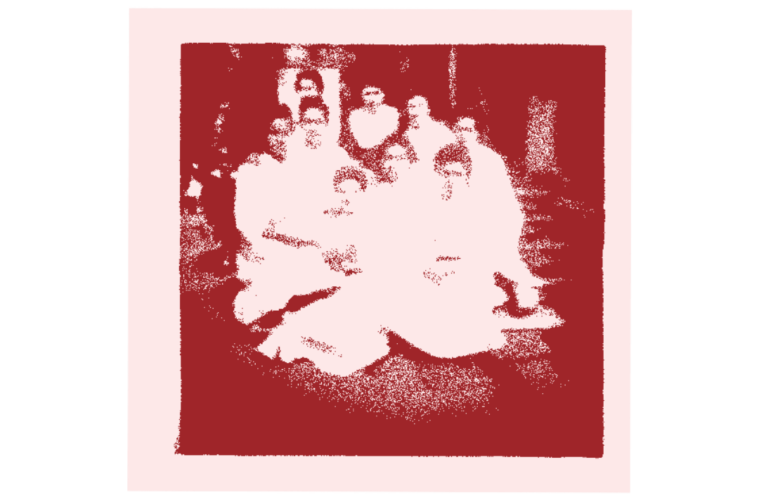
Words and Artworks by Lama Abdelgelil
This piece is part of the “Fields of Gestures” issue
Growing up as part-Palestinian in Cairo, I’ve spent more time thinking about whether I’m allowed to make art about Palestine than actually making it. For many of us in inherited diasporas, the question of permission is only the first layer. Underneath it is another kind of pressure, which is the expectation that if we do make something, create something, its role should be resolving the tension, landing us somewhere, and telling us and everyone else where we belong.
That pressure shaped how I moved through my identity for a long time, as I believed that this history is not fully mine. Rather than accepting that partiality as legitimate, I spent years trying to collect every piece of my family’s history, believing that completeness would grant me the right to claim it or to speak about it.
A while ago, I decided to start a personal project. Through story retellings by relatives, the few articles and website pages I managed to find online, and the three Palestinian archivists whom I repeatedly asked for more information, I began piecing together my family history into a small zine. What I found was not a coherent narrative, but rather fragments. Many of these, to some extent, will remain incomplete. This is what pushed me to explore how fragmented archives, emotions, and memory shape my attempts to engage artistically with a Palestinian history that is both mine and not fully mine.
Above all, it’s important to remember that there is rarely coherence in exiled families’ stories to begin with. While there are documentation initiatives in place to preserve these histories, the bigger picture sometimes remains incomplete. In my own family, many of the older 1948 Palestinians also simply did not like talking nor remembering what they’ve lost in the Nakba. In Reflection on Exile, Edward Said writes that exile is a discontinuous state of being in which people are cut off from their histories and pasts. So, fragmented family histories become structural because exile interrupts the continuity and transmission of said histories. Like me, this may cause artists to feel urged to try and piece together something that is inherently incomplete due to the very nature of the condition it exists in.
So, the zine I started became less a documentation of family history but more a record of its absences, the parts that remain unknown, and might remain that way, alongside the parts that I do know and am affected by.
Postmemory & Carrying Stories We Didn’t Live
The tension between inheritance and distance raises the question of what it means to engage with a history that is both yours and yet not fully yours. Marianne Hirsch describes a similar condition through the concept of postmemory, which is the relationship that later generations have with histories of violence and loss they’ve inherited from previous generations but have not directly experienced themselves.
Although Hirsch herself also argues that with postmemory comes a risk of overly identifying with those who directly experienced these events, thus, appropriating their experiences. And, that was my own personal fear as well. Who am I to feel something about what my grandmother has experienced when I haven’t experienced something remotely similar myself? But, I’m her only grandchild, so if I don’t feel something for what she went through, then who will?
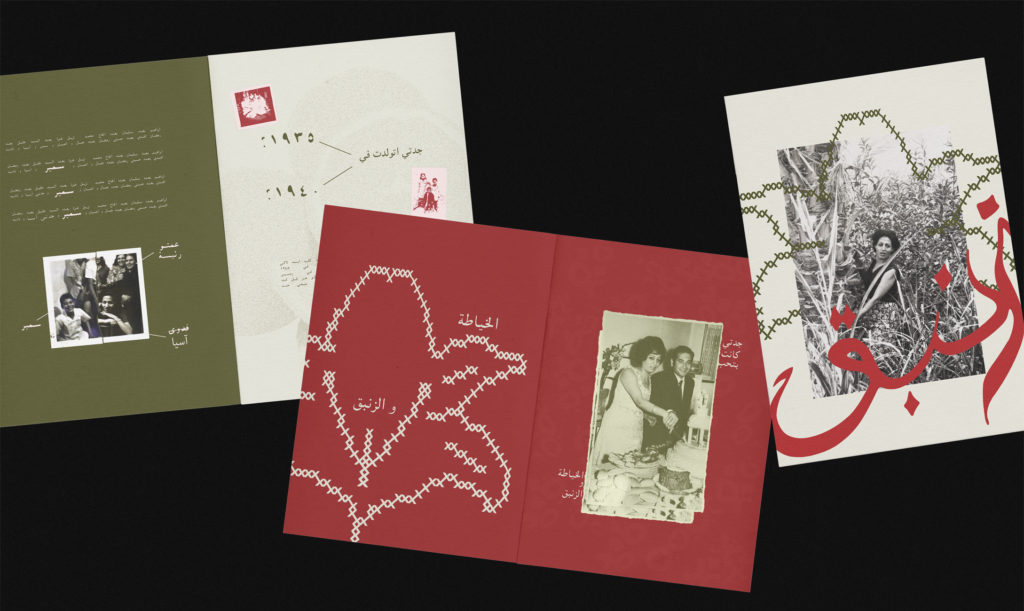
Artwork by Lama Abdelgelil
Fractured Archives as a Site of Examination
While exploring what it means to treat incomplete archives themselves as material, I stumbled upon Kamal Aljafari’s work, particularly his documentary titled Recollection.
In Recollection, Aljafari works with footage from Israeli films that were shot in his hometown, Yafa, in the mid-to-late 1900s. In most of these films, Palestinian neighborhoods and people appear as backdrops, completely erased from the main narrative.
Aljafari digitally removes the main Israeli characters from these scenes, and tries to find the Palestinian presence in the remaining empty streets, corners, and buildings. He ended up finding his own uncle in the background of one of the movies, as well as childhood friends. Rather than trying to reconstruct a seamless historical narrative, Aljafari works with the conditions under which that narrative was fragmented in the first place. In this sense, he finds evidence of existence within that absence itself.
Emotional Limbo as a Site of Creation
When I was throwing myself into researching my family history, I wasn’t only trying to overcompensate for my self-perceived lack of right, but also for not being able to have clear, strong emotions towards this. Because, how does someone feel in this kind of situation? I grew up in Egypt, in relative safety, away from the conditions that produced this displacement. But, this is not to discard or undermine that I was also affected in other ways, having been raised by my grandmother and living with her for nineteen years. I remember relatives going back to Palestine and retelling what they found of our old house, or hearing my grandmother speak about her childhood neighborhood and the few streets she remembers from when she was eight.
Conditions of displacement, whether inherited or experienced, do not always produce clear emotional responses just as much as they do not produce clear histories. The emotional landscape of such experiences can remain ambiguous, not because of a lack of emotion, but because there’s a lot of tension and in-betweens much like the ambiguities surrounding identity itself.
Emotional limbo, for lack of a better word, is exactly what I was feeling. This is an idea Elia Suleiman explores in his movies. Although the conditions he lives under are very different from mine, him being a Palestinian living under occupation in Nazareth, and me being a person who spent their whole life in Cairo, I still found his ideas very emotionally relevant. Rather than narrating the history of the conflict, his movies focus more on the present emotional condition of Palestinian life. What compelled me most is that in his films, which he both directs and acts in, Elia Suleiman moves through the scenes as a silent observer and witness. There was something in that silence, the act of moving through and witnessing without resolving, that felt closer to my own position. It allowed me to see that just being present in this tension is a valid state to be in, rather than trying to produce meaning or resolution.
Refusing Closure
The idea of one coherent, static identity is a colonial concept to begin with. Colonial systems rely on fixed categories: native or foreign, insider or outsider. But diasporic lives rarely operate within these boundaries. And, these boundaries can sometimes cause us to forget that identity can be complicated, and that this partiality is also legitimate.
The zine I started was never going to resolve the questions I have, and neither will this text. Both remain attempts to map something that cannot be fully mapped. Belonging, when it’s fractured, doesn’t resolve. And neither should the work.