
Words by Ahmad Makia
This piece is part of the “Fields of Gestures” issue
This article was written in collaboration with Hyperhouse studio.
You can find another version of this article here.
On 28 March 2026, at a No Kings Rally in New York City, comedian and social media personality, Lionel Leede, asks a protester, “Isn’t it a little homophobic that we’re so focused on the straights of Hormuz — and not the gays of Hormuz?” Leede satirizes the ‘Strait of Hormuz’ from a strategic geographic waterway for the dispersal of energy, food, and goods, to a symbol of heterodominance. The protester at the rally responds to Leede: “I think it’s just, historically, gays have always been very discriminated against, which is wrong on so many levels… even in war … It just takes more reform in government — obviously — and educating society.”1
Most interactions with this now-viral video meme, infamously circulating as “Free the Gays of Hormuz,” have become a real-life illustration of the corruption of global solidarity struggles by ‘woke’, ‘nepo’, and ‘lefty’ groups, who do not know the context or the reality of the causes they are standing for. Yet, the dialogue reveals broader assumptions and nuances: it treats the idea of advocating for, or humanizing, Hormuz as simple-minded, since the landscape is not a living entity but a point of passage; a dry, linear, transactional backdrop for the movement of extracted goods. For Leede, Hormuz is a geographic name; thus, his remark centers on its imagined anthropomorphization and treats identity and belonging within this maritime site as fiction rather than fact.
Hormuz can be flattened into a militaristic, humanless economic zone, given its geopolitical importance, but the region is not simply an overlapping maritime area for the movement of vessels governed by modern states; it is an active identity and human geography. In historical documents, the Kingdom of Ormus, the region’s archaic Latin spelling, was described as a formidable thalassocratic society flourishing between the 10th and 16th centuries – a political power derived from its position at sea and favorable maritime routes. Like Ancient Athina, Phoenicia, and Minoa, chronicles describe Hormuz as a maritime hybrid society and a site-specific commune of scattered possessions—coastal cities, islands, and strategic ports—rather than a single landmass.
Citizens of Hormuz were historically called of the Monsoon and belonged to no nation: Persians, Arabs, Turks, and merchants from China, Java, and East Africa, all deeply involved in the global trade of pearls, horses, precious stones, and spices, who were for Europeans ‘sacarens’ and maintained an outward adherence to the creed of Muhammad.2 Because of its location and environment, the people of Hormuz were defined by situated citizenship, living with the currents of the monsoon winds and seasons, adapting to the extreme summer climate (described in Persian as Jahim, or hell) and the impossibility of settled permanence. Belonging to this “black” region, as described in the diaries of Venetian traveler Marco Polo, meant collective immersion in Hormuz’s environment and natural cosmology.3 In more recent scholarship, Hormuz has also been identified as part of the broader Indian Ocean medieval free-port archetype, akin to an anarchic ‘Temporary Autonomous Zone’, which describes socio-political marginal spatial formations that elude traditional structures of control. These places usually dissolve once a powerful authority takes notice of their habits and activities.4
While maritime societies and geographies, such as historic Hormuz, can be easily romanticized as liminal, collective spaces where forms of belonging are fluid and porous, even intersectional, an important question arises: who moved and resided in Hormuz? Communities severed from the logics of nationalism, sanguine, and terra: sailors, minorities, exiles, refugees, orphans, widows, fugitives, and gays.
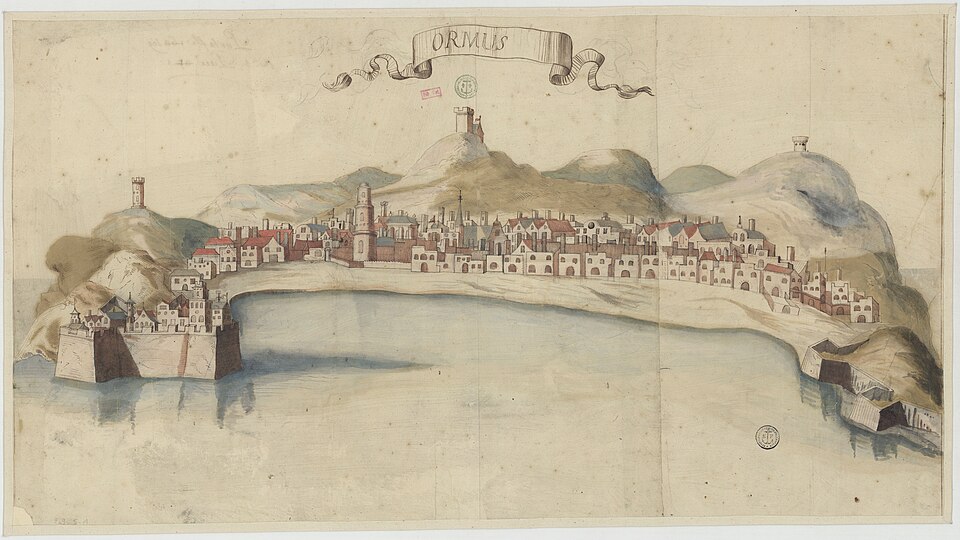
Image: Watercolor depicting the Island of Hormuz, circa 17th century. Source: Gallica, Bibliothèque nationale de France (BnF).
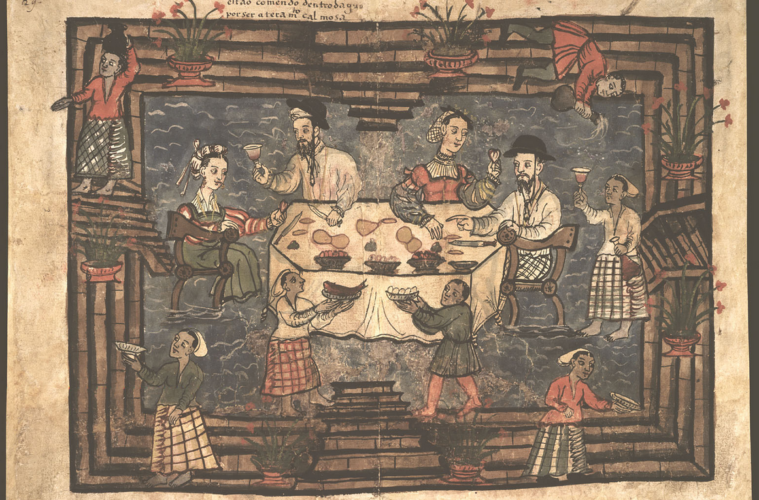
Featured image: Illustration from the 16th century Portuguese Códice Casanatense showing a meal in a Portuguese household in Hormuz. The room was intentionally flooded to cool the space. Inscription: “Portuguese folk of Hormuz that are eating in water for the land is very warm.”
When medieval travelers, diplomats, and colonels from Asia, Africa, Europe, and even mainland Persia encountered the region of Hormuz, they were stupefied by its environment and inhabitants. One of the main qualities that united the observations of all these outsiders was the men’s appearance and manner. Along his cross-continental travels, Ibn Battuta spoke of Hormuz as a “large and fine, with magnificent bazaars. The inhabitants are men of noble character and refined habits. I saw there a people who combine the gravity of the Persian with the grace of the Islander.”5 Abdur Razzaq Samarqandi, who in the 15th century traveled from Timurid Iran, wrote that Hormuz’s inhabitants were “clothed in silk and gold” and that they were sahib-i jamal, possessors of beauty and elegance, and that their speech was sweet and manners polished. He also likened them to sanam, the Persian-Arabic word for idols, invoking that they are like beautiful statues and sculptures, and similar to the performers of the tamashakhaneh, the theater.6
The use of sanam and tamashakhaneh perhaps suggests a certain caricaturization and campiness associated with the region’s male inhabitants. It alludes to a dissonance the author experiences from the Persian mainland. Hormuz technically belonged to Timurid Iran as a vassal state at the time of the author’s observation, yet it stood in stark contrast to the rugged, warrior-like environment of the interior. Sanam is also the baroque visual and material culture that existed in the Arab-Persian region prior to the monotheistic, aniconic Islam, generally considered, in its philosophy, as a purification of the senses and the soul. In both Battuta and Samarqandi, the people’s looks are also aligned with the place itself, which they describe as consumed by the pursuit of excess, wealth, and luxury.
This commentary on the men’s looks and manners, the city’s ample fortunes, and sense of exhibitionism is also echoed by Ma Huan, a Muslim interpreter for the Chinese Admiral Zheng He. Zheng He was a Chinese Muslim seafarer who was among the first to establish contacts with the ports of India, Iran, and Arabia in the modern era. His trading voyages encompassed many cities and created some of the earliest cartographies of the Hormuz region and the Indian Ocean from a Sino-Islamic perspective, during the same century of Samarqandi’s visit. In the interpreter travelogues, Hormuz’s inhabitants are described as stalwart and fine-looking; their limbs and faces are refined and fair; they are wealthy, and wear long robes and hats, made of silk and cotton, and of a comfortable disposition.7
All ‘outsider’ or first-time encounters with the region called upon the writer to remark on the mannerisms and specificness of the men of Hormuz and the city they live in. Only when reading travelogues by Europeans does one encounter how the same polished men were perceived as ‘abominable’, shamed as ‘womanly’, and even outed as ‘gay’. While Ibn Battuta, Samarqandi, and Ma were impressed by the looks and manners of the men of Hormuz, they praised and were surprised rather than dismissive of their gendered identities.
Italian explorer Ludovico di Varthema in 1503 writes “The inhabitants are very polite… the men are dissolved in pleasure, and they have a certain kind of ointment with which they anoint themselves, so that they appear to have no hair on their bodies, and they appear to be like women.”8 In his diaries, Gaspar Correia, a chronicler of the Portuguese conquest of Hormuz, during the 1507 expedition, calls the “people [of Hormuz] are so effeminate and given to the vices of the flesh that they have no strength for war. They trust in their riches and their walls, but they are like women in their hearts”. Not only did the men of Hormuz epilate and perfume themselves, but they also partook in an “abominable wickedness” or Pecado Nefando, ‘nefarious sin’: sodomy.9 Varthema claims, “They are also greatly addicted to that most filthy vice which is not to be named.”10 In both instances, neither writer is able to name the act but instead places a value judgment on something which, in their own domain of sociosexual conditioning, is conceived as irregular or shameful.
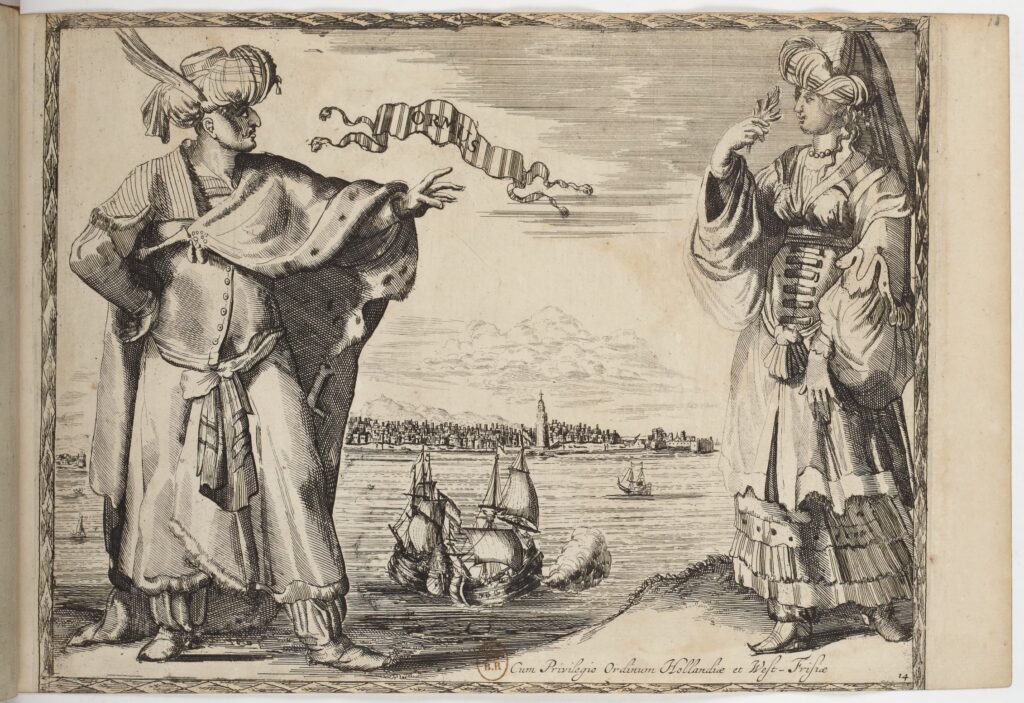
Image: Illustration from “Costumes des quatre parties du monde” – Hormuz, engraved in the style of Jan Luyken, 1670.
What these explorers encountered was the lifestyle of merchants in Hormuz, especially among wealthy subjects. Across the Islamic and Persian world, the sponsoring of beardless amrad, known as polished and beardless boy youth, and mukhanathun, was very common and they most probably lined the streets of the city of Hormuz, like ‘idols’. In essence, sex workers for pederasts, amrad were trained in music, poetry, and the arts of the bath. They were draped in silk, perfumed with sandalwood, ambergris, and musk, and dilapidated using nora, a quicklime-and-orpiment paste, to create a marble-like effect on the skin. Between childhood and bearded manhood, amrad in the Farsi Islamic imperial hemisphere, were sometimes even more than workers and akin to artists–again as ‘idols’.11 They are conceived as vessels and portals to the otherworldly, through the Sufi practice of Nazar, beholding, in which the city of Hormuz, especially, was characterized as a place where the ‘divine’ was visible in the faces of the perfumed youths.12
The Kingdom of Hormuz, perched at the mouth of the Gulf, served as a liminal space where the rigid orthodoxies of the mainland dissolved into an atmosphere of immense luxury and erotic fluidity. Here, the figure of the amrad—the beardless youth—transcended its local context to become an idealized locus where commerce, spiritual desire, and sexual ambiguity intersected.13
Not only was Hormuz a den for perfumed boy youth, but also something of a babel of courtesans from across the Mediterranean, Asia, Africa, and India. Many of the sex workers were educated, played instruments, and sang poetry. The practices that were commonly engaged in included polyamory and multiple partners, public displays of song and dance, and the use of aphrodisiac foods and oils.
In addition, the sexual landscape of the broader Shia region is legitimized under Zawaj Mu’tah (temporary union). An arrangement usually popular in port cities and major transit ways, zawaj mu’tah is a religious decree that allows for temporary, and not necessarily reproductive sexual relationships, for widowers, divorcees, migrants, wanderers, and communities who are unable to permanently settle in a place or are outcasts by virtue of conservative sexual norms. Temporary, pleasure-based marriages are practiced across the Indian Ocean littoral, such as the Maldives, in Shia nations, namely Iraq and Iran, and it is considered a major pathway for income generation for independent and single women until today. In the case of Hormuz, because it was governed by the monsoon winds, thousands of men were stranded for months, waiting for the winds to change, and thus entered into temporary legal marriages with local or migrant women and qiyans, singing girls, for the duration of the sailing season.14
When exploring the narratives about sex, the body, belonging, and citizenship in Hormuz, these lifestyles and social communes stood in stark contrast to the land-based emporiums and religious guilds of empires and early nations, usually defined by harvesting the land and collecting tax, who divide and identify based on class and family name, who enforce allegiance to a distant and all-consuming higher force, be it a city capital or spiritual head.
What these narratives reveal is dissonance: bodies in Hormuz were exposed to the whims of winds and chance, to pleasure and laterality; they do not function within biopolitical conquest and institutional control. The European traveler, and even the ‘native’ mainlander, who encountered the region personifies the bulwark, hairy, timid conqueror who is looking upon this area with disgust and revulsion as well as lust and desire. The Hormuzi is oiled, refined, cultured, bathed, and embodied. By modifying and emphasizing their bodies and looks, the Hormuzian signaled a departure from a ‘warrior’ state toward a ‘civilized’ and ‘theatrical’ state, and hence why cosmically and spiritually, they needed to be governed and disciplined, or in the words of Gaspar, “[our] Lord delivered them into the hands of the Governor [Albuquerque].”15
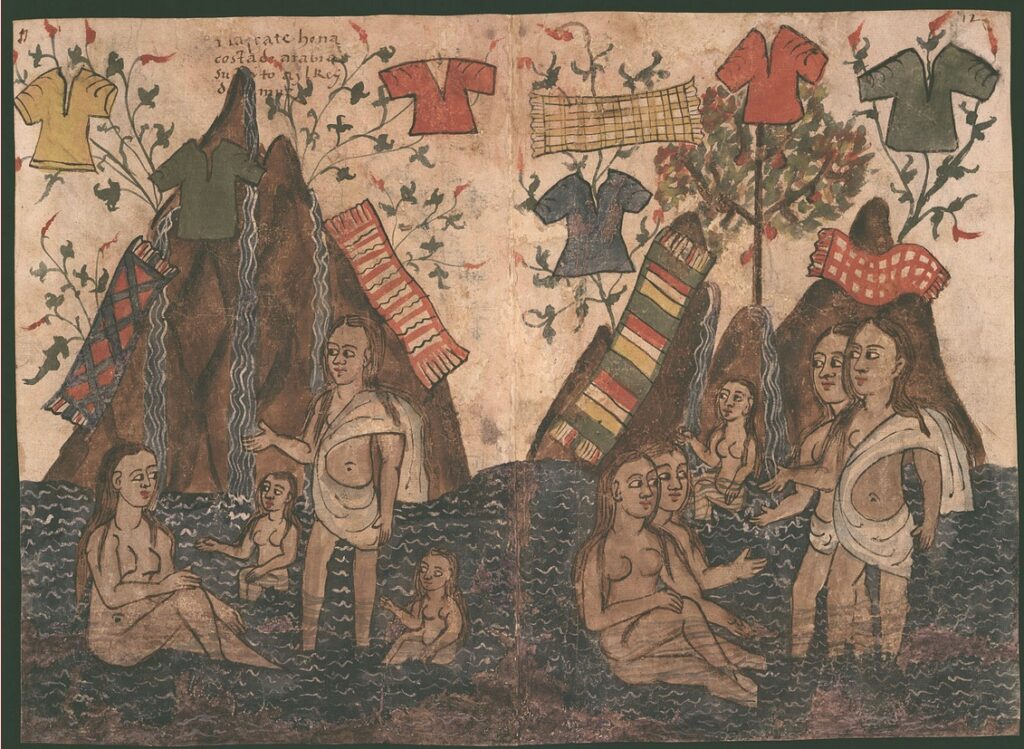
Image: Illustration from the 16th century Portuguese Códice Casanatense depicting a bathing scene in the city of Muscat, Oman. Inscription: “Muscat lies on the coast of Arabia and is subject to the King of Hormuz.”
While the Arab and Persian Worlds are part of what is considered the Okimuneake of world civilization histories, this is limited to the Fertile Crescent, the Mediterranean, and their river nations. Yemeni and South Arabian tribes’ influence within this Oikoumene, or the “habitable world”, emerged with the missionary exodus of Islam from the 600s and its effectiveness in hybridizing and engaging with very different parts of the world. The spiritual spread was an economic one, supplanting the historic trade and land routes between Europe and Asia with Indian Ocean vessels and carriers linking ports along the Asian and African rims, creating what we today refer to as the Indian Ocean world, from Mombasa to Singapore to Colombo to Hormuz.16
It was this particular worlding around the Indian Ocean that the Portuguese disrupted when they colonized Hormuz and the entire Yemeni and Gulf coasts, the island of Bahrain, Bab El Mandab, Basra, Al Qatif, and eventually the Indian and Chinese islands of Goa and Macau. Alfonso de Albuquerque, the pioneer of the early colonial network, named Hormuz as the “Key to the Orient”.17 He was the first to levy transit fees on every vessel passing through it, and he and his army played a central role in eradicating the port’s ethnic and social diversity.
Under his leadership, Hormuz was transformed from an aquafied port city into a fortified center of imperial statecraft. Lasting an occupation of nearly 116 years, the entire character of the city was transformed from mud and salt architecture to rock masonry, namely garrisons and fortresses, and became centered around the walled city of The Fortress of Our Lady of the Conception. Today known as the Portuguese walled fort of Hormuz, ruins like it are found around the coastline of Iran and the Arab Gulf, such as the historic city of Julfar / Al Hamra in Ras Al Khaimah, Khor Fakkan, Musandam, Dibba, and Kalba, in present-day Omani territories of Qalhat and Sohar, as well as the islands of Qeshm, Bahrain, Kish, Abu Musa and the Tunbs. He too was the first to entirely take over the Strait and collect passage tolls on all ships moving through the seas, overriding existing socioeconomic and political balances.
On the island of Hormuz, historically Jarun, the capital city of the Kingdom of Hormuz, Albuquerque built a fortress that was originally cut off from the rest of the island by a deep moat. This architectural move castrated the city by separating the site of power, the fort, from the site of leisure and commerce, the bazaar. Power was no longer distributed through the market; it was concentrated in a single, unyielding stone point. To create clear lines of fire for Portuguese cannons, Albuquerque cleared the areas surrounding the fort. The ‘babel’ of mixed-use buildings, bathhouses, and temporary shelters was leveled to create something of an active zone of observation and potential killing, replacing the intimacy of the alleyways with the visibility required for colonial surveillance.
Under Portuguese rule, the elite merchants were displaced by military governors. Albuquerque encouraged his soldiers to marry local women, often from the families of defeated elites, to create a class of casados, married settlers. This was a move to root the rather transient population. In a famous 1507 episode, Albuquerque forced his own captains—and local elites—to physically carry stones for the fort. For a merchant class that defined itself by polished manners and fair limbs, this act of manual labor was a symbolic stripping of their refined status. Albuquerque’s heteropatriarchy re-engineered the body from a vessel of pleasure to one of hard labor. It instilled a crusader mentality throughout the Hormuz interregion, viewing the city’s perfumed men, who are given to “abominable wickedness,” not as a cultural difference but as a military liability. Reports from the era show a systematic attempt to pathologize homoeroticism, sex work, and non-reproductive-based sexual relationships, framing it as a ‘sin’ that justified brutal colonial methods as a ‘restoration of order’.18
By imposing the rigid, patriarchal structure of the Catholic household, the Portuguese sought to kill the seasonal marriages, amrads, and expanded intimacies that had defined the city’s sexual identity. The liminality offered by Hormuz became a governable space and a hardened passageway for extractive capitalist functions. Attributes associated with the male community of Hormuz became the moralizing and colonizing logic for the alpha Portuguese conqueror: a man with ‘smooth’ skin, drowning in pleasure, is a man to be touched or looked at; the Hormuzian body was a site of receptive pleasure rather than active conquest.
Effeminization or ‘gayification’ of identity practice in Hormuz was because the traditional empire, even that of Timurid Iran, pointed to a sexual culture that was not centered around demographics and reproduction, inheritance and property. Instead, there was an interest in the act of intercourse as a means in itself. It terrifies polite, conservative culture as we find in the Portuguese example, and through institutionalized patriarchy and gender discrimination, where if a man is ‘dissolved in anal pleasure’ with a perfumed youth or a seasonal wife, it means he is not investing in the reproduction and eugenicist logics of the collective ‘human species’.
Additionally, the Hormuz region was a sterile salt dome. In traditional imperial logic, land that cannot reproduce is barren or queer. By building a global trade capital on a non-reproductive landscape, Hormuz subverted the patriarchal link between fertility, land, and the state. Its wealth didn’t come from the ‘womb’ of the motherland, but through commerce and laterality: The Empire wants fixed borders; Hormuz is a shifting port. Manhood wants strength and stoicism; Hormuz celebrates sex, music, and play. Nationalism wants ethnic purity; Hormuz was a landscape-driven melting pot, and reveals that imperialism is inherently homophobic/queer-phobic because it fears fluidity and indefiniteness.
Traditional imperialism is very basic and territorial, like the men who author it. They define power through the conquest of soil, the drawing of borders, control of resources, and the protection of a fixed ‘motherland’. It necessitates a specific type of hyper-masculinity—the soldier-settler who is rooted and unyielding. A man who is perfumed and relational is harder to conscript into a territorial war than a man who is of his people and his land.
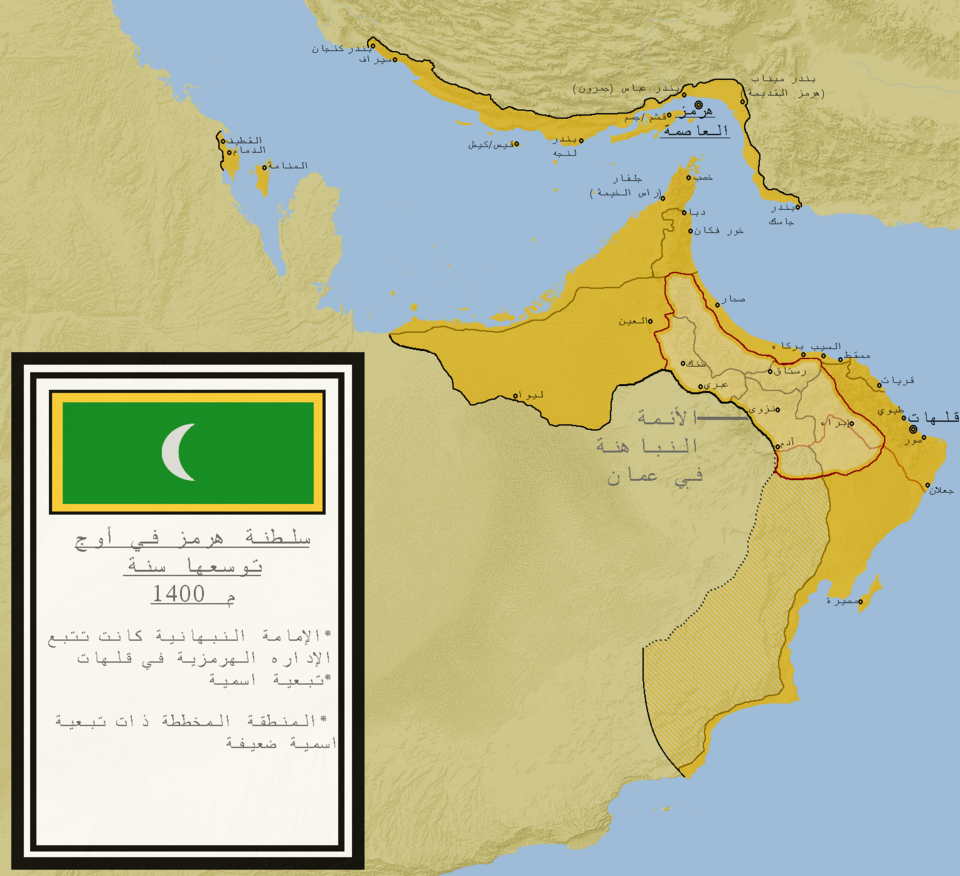
Image: Map of the Kingdom of Hormuz at its greatest extent, c. 1400 CE. Source: Mohammed Hatem,
History of the Huwala Arabs: A Documentary Historical Study (1997).
Hormuz evaded this and communed a different relational society altogether. It was not ruled by a mammalian logic and a dog-eats-dog cycle; it chose to treat identity as a site of pleasure rather than of inscription and devotion; it had to identify with seasons, environments, and circulations rather than with ideologies and militaries.
This is why it has to be captured and destroyed.
In Middle Persian – the literary language of the Sassanian Empire (224–651 CE) – anal intercourse is described as kun-marz, which literally means ‘buttock-rubbing’. In modern Persian, marz means ‘border’ as in the border of the state or homeland and the Arabic word tajavoz is used to describe both ‘rape’ and the ‘invasion’ of one country by another. Thus, Iranian nationalist discourse sanctifies the protection of the national borders of the ‘motherland’ against foreign invasion as a matter of masculine ‘honour’.19
- No Kings: Free the Gays of Hormuz / accessed April 27th 2026, Youtubeand.
- Marco Polo, The Travels of Marco Polo (Translated by Henry Yule, Vol. 1, Chapte, which, 40).
- The characterization of the population as “black” in this period likely reflects the diverse ethnic makeup of the maritime port, which attracted a large number of sailors, merchants, and enslaved laborers from across the Indian Ocean, the East African coast, and the Arabian Peninsula.
- See Hakim Bey, Pirate Utopias: Moorish Corsairs & European Renegadoes (, and Sacred Drift: Essays on the Margins of Islam (1993).
- Ibn Battuta, The Rihla (Vol. 2, Chapter on the City of Hormuz), H.A.R. Gibb (Translator), The Travels of Ibn Battuta, A.D. 1325–1354 (Hakluyt Society, 1962).
- The original quote in Persian is “”…و اهل آن بلده به غایت متجمل و با زینتاند، چنانکه گویی صنمی در تماشاخانه روزگار پدید آمدهاند…” in Kamal ad-Din ‘Abd ar-Razzaq Samarqandi, Maṭla’-i sa’dain wa maǧma’-i baḥrain, ed. ‘Abd al-Husain Nawa’i (Tehran: Mu’assasah-i Mutali’at va Tahqiqat-i Farhangi, 1993).
- Ma Huan, Ying-yai Sheng-lan: ‘The Overall Survey of the Ocean’s Shores’ [1433], trans. and ed. J.V.G. Mills (Cambridge: Cambridge University Press for the Hakluyt Society, 1970).
- Ludovico di Varthema, The Itinerary of Ludovico di Varthema of Bologna, from 1502 to 1508, trans. John Winter Jones (London: Hakluyt Society, 1863).
- Gaspar Correia, The Three Voyages of Vasco da Gama, and His Viceroyalty: From the Lendas da India, trans. Henry E.J. Stanley.
- Ibid.
- See Khaled El-Rouayheb, Before Homosexuality in the Arab-Islamic World, 1500–1800 (University of Chicago Press, 2005) and Dustin, M., Ferreira, N., Matin, K., Rezaei-Toroghi, M., & Soloaga, I. (2026). From the Amrad to ‘the Gay’: The Making of Queer Identity in Iran. In Decolonizing queer migration: Iranian Voices in exile (pp. 34–56). Bristol University Press.
- See Abdelwahab Bouhdiba, Sexuality in Islam (Saqi Books, 1998) for Islamic customs of skin-smoothing and James Atkinson (translator), Customs and Manners of the Women of Persia (Royal Asiatic Society, 1832) for nora applications.
- Hakim Bey, Sacred Drift: Essays on the Margins of Islam (Autonomedia, 1993, p. 45).
- See Ibn Battuta notes on Zawaj Mutah in the Indian Ocean littoral as well as Barbosa diaries on qiyans and courtesans. Additionally, Hakim Bey works Sacred Drift: Essays on the Margins of Islam (1993) and Weaver of Tales: Persian Picture Rugs (1980), co-authored with Karl Schlamminger, on general sexual attidues prevalent in Hormuz and mystic customs.
- Gaspar Correia, Lendas da Índia, vol. 1 (Lisbon: Typographia da Academia Real das Sciencias, 1858).
- See Chaudhuri, Kirti Narayan. 2008. Trade and Civilisation in the Indian Ocean: An Economic History from the Rise of Islam to 1750. Cambridge University Press and Tagliacozzo, Eric. 2022. In Asian Waters: Oceanic Worlds from Yemen to Yokohama. Princeton University Press.
- Cartas de Affonso de Albuquerque, seguidas de documentos que as elucidam (Letters of Afonso de Albuquerque). // The Commentaries of the Great Afonso Dalboquerque, Second Viceroy of India, translated by Walter de Gray Birch (London: Hakluyt Society, 1875–1884).
- Brás de Albuquerque, Commentaries of the Great Afonso Dalboquerque, Second Viceroy of India. Translated and edited by Walter de Gray Birch, The Hakluyt Society, First Series, No. 53, 55, 62, and 69, (London, 1875).
- Dustin, M., Ferreira, N., Matin, K., Rezaei-Toroghi, M., & Soloaga, I. (2026). From the Amrad to ‘the Gay’: The Making of Queer Identity in Iran. In Decolonizing queer migration: Iranian Voices in exile (pp. 34–56). Bristol University Press, p 36.