
Words and Images by Parham Ghalamdar
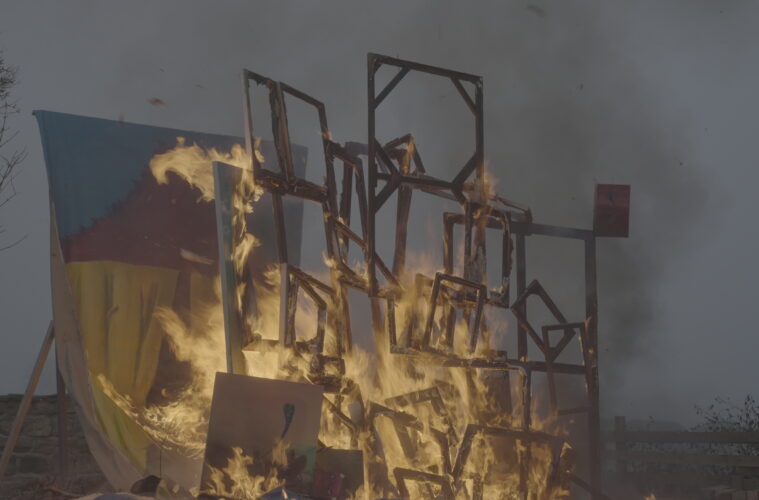
Featured image: Film still from The Sight is a Wound, showing the burning of over fifty paintings. By cinematographer Dean Brierley, director and founder of Caustic Coastal.
This piece is part of the “Fields of Gestures” issue
I made The Sight is a Wound in response to Israeli genocide in Gaza. It was a moment when painting began to feel morally empty in my hands. The war was already arriving as an image, minute by minute, through phones, feeds, clips, and reposts. Death was being watched, circulated, argued over, and flattened into content. Under those conditions, I could no longer trust the old promise that an artwork might clarify, elevate, or redeem what it touches. I did not want to paint horror. I did not want to aestheticise grief. I did not want to add one more image to a world already drowning in images of the unbearable.
So I decided to burn over fifty of my own paintings.
Some were small. Some were large. Some were displayed in institutional and commercial exhibitions worldwide. And some followed me for years. I burned them in an open landscape, in North England, and filmed the process. It was more of a private performance of grieving; a funeral. What mattered to me was refusal. I wanted to push painting into a point of collapse and stay with that collapse long enough to learn from it. The fire was a way of ending a relation to image-making that I could no longer defend.
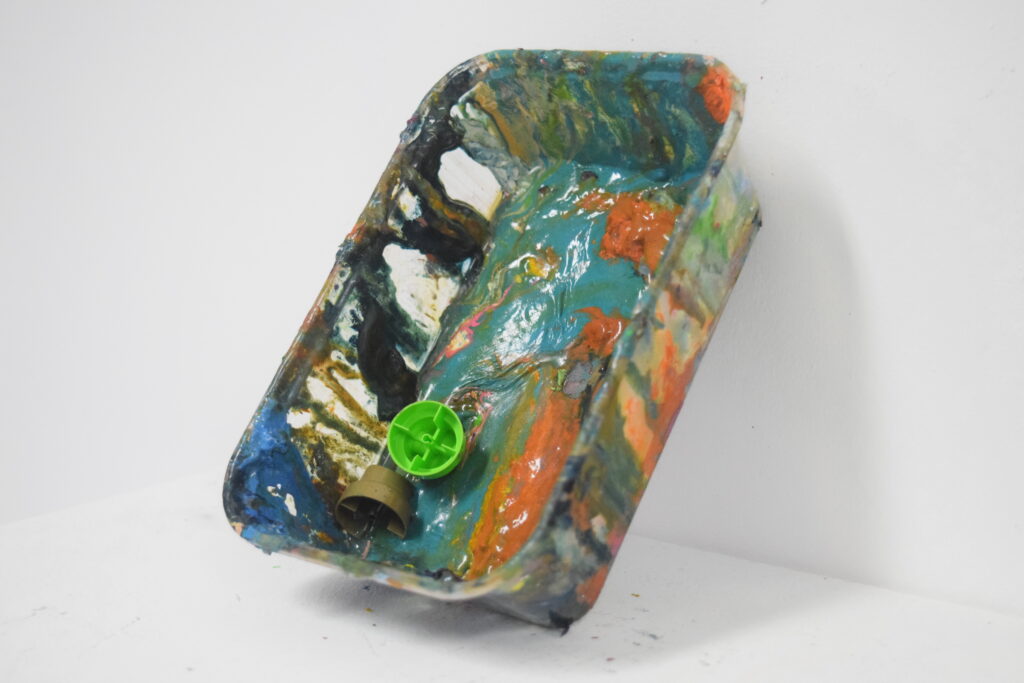
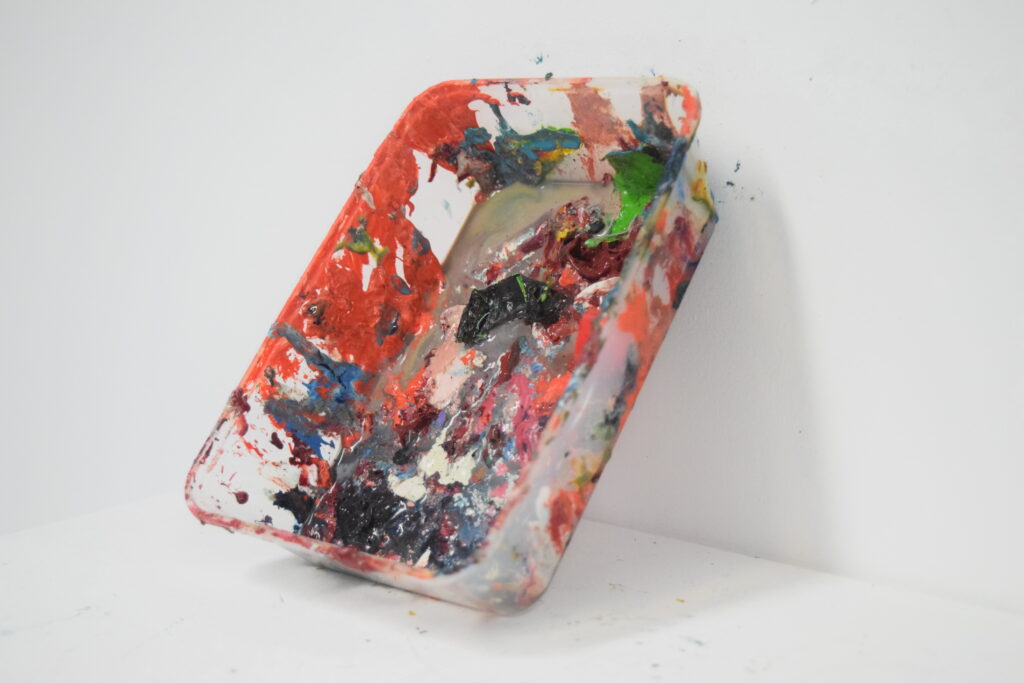
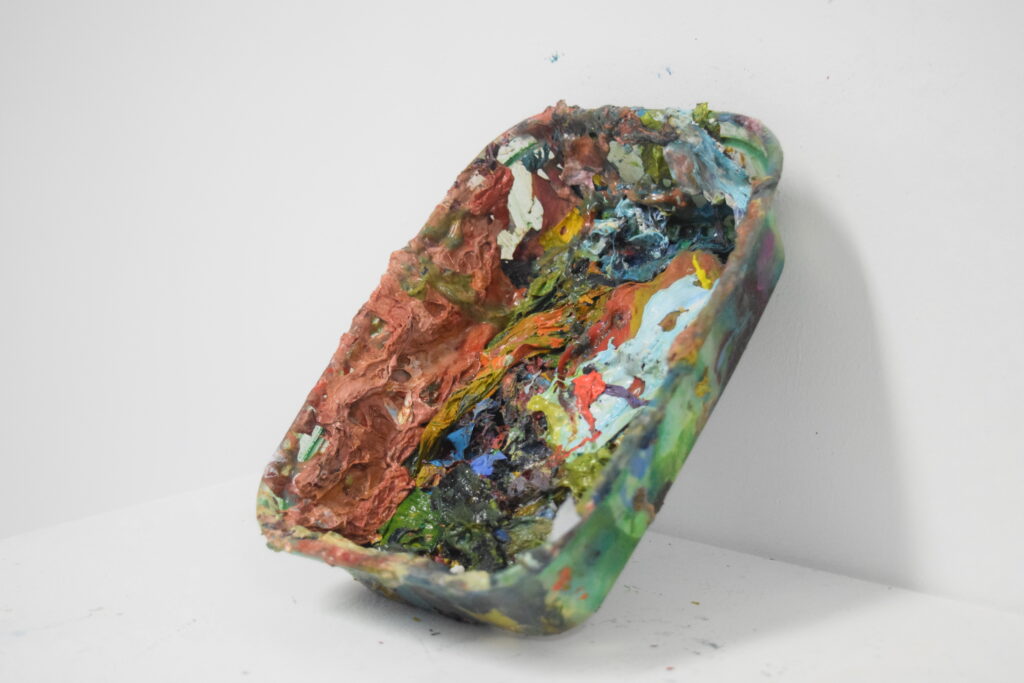
Colour palettes of burned paintings, photographed as an accidentally preserved residue of studio work.
This refusal came from anger, but also from the exhaustion of a medium. For months, I had felt a widening gap between the urgency of political reality and the slow rituals of the studio. There was something obscene in the idea that I might keep stretching canvases, mixing colours, refining surfaces, and speaking about nuance, while genocide was being live-streamed in plain sight.
I am not saying art must always answer war directly. I am saying that in this case, I reached a limit. The relationship between painting and witnessing broke down. The frame began to feel complicit. To frame is to select, and to select is to leave out. Under these conditions, I notice that even our attention is compromised.
The film came out of that crisis. It was shaped by Gaza. And by the feeling of helplessness in watching mass death pass through image systems built for speed, distraction, and repetition. Yet another fear sat quietly behind it. I was also carrying the thought that this kind of violence could one day come for my own people too. At the time that fear stayed in the background, half-formed, more like pressure than statement. I did not know how quickly the context around the work would shift. But I was very conscious that I am sitting at the same table which is serving fire to the Palestinians.
As time has gone on, the film changed for me. What began as a work shaped by Gaza has also become, in part, a work that returns me to Iran. I do not say that to blur the two or fold one into the other. Their histories are not the same. Their conditions are not the same. But war moves. Its image regimes move with it. Fear moves with it. A work can stay physically unchanged while its political charge deepens, widens, and hardens. What I made out of one wound now speaks through another as well.
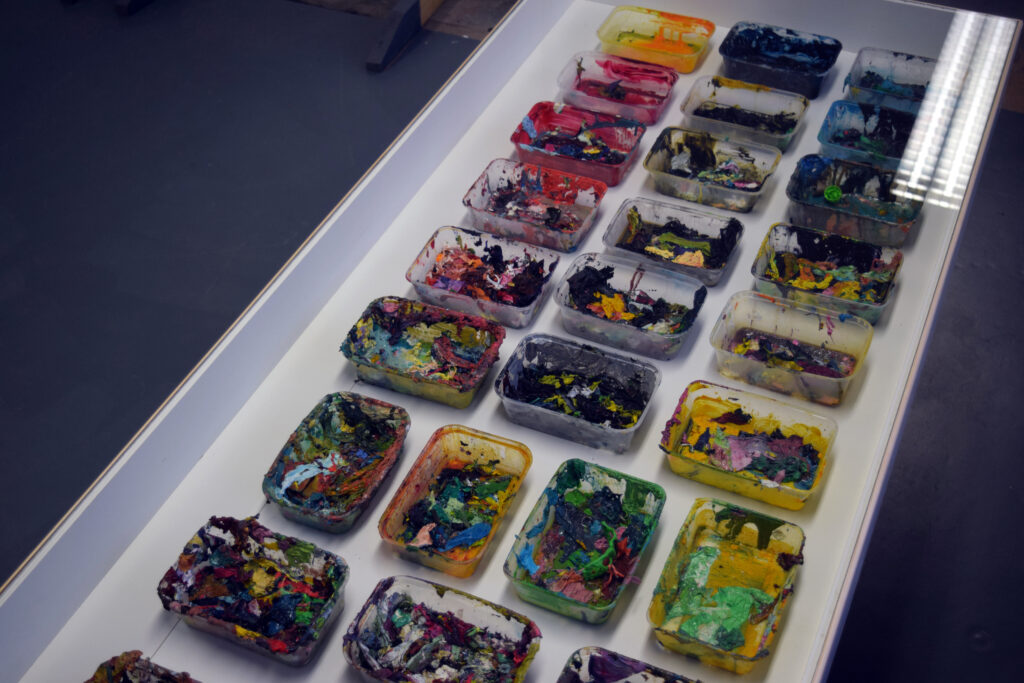
Vitrine display of dried colour palettes from the studio, shown as forensic remains during the Good Eye Projects residency in spring 2025.
After the burning, I could not go back to the studio and carry on as before. I could not act as if the fire had cleared the ground for a fresh start. The studio itself had changed. It no longer felt like a place for invention. It felt like a scene after an event. I found myself looking at what had been left behind: ash, damaged supports, still images from the film, and the dried paint palettes that had gathered over years of work. These were not new works; I didn’t even care if it was art or not. They were remnants and witnesses. Yet they seemed to hold more truth than any fresh canvas could.
That shift led me toward a different kind of attention. I stopped asking what I could make. I started asking what remained. During an art residency later, I treated the studio less as a site of production and more as a site of evidence. The materials in it were no longer tools waiting to be used. They had become records. The mood changed with them. The studio lost its romance. It became colder, more clinical, more exact. I was no longer looking for expression. I was looking for residue, a radical curation of what should be carried over the threshold.
The dried palettes became central to this turn. These small plastic containers had once held mixtures of oil paint, pigment, solvent, dust, time, and indecision. They were casual things, never meant for display. They existed at the edge of the work, close to the hand, close to labour, close to repetition. After the film, they came to look like compressed archives of the paintings that had burned. Their colour had not disappeared, but it had congealed. It no longer opened outward into an image. It sat there in thick, cracked, clotted deposits, like matter after impact.
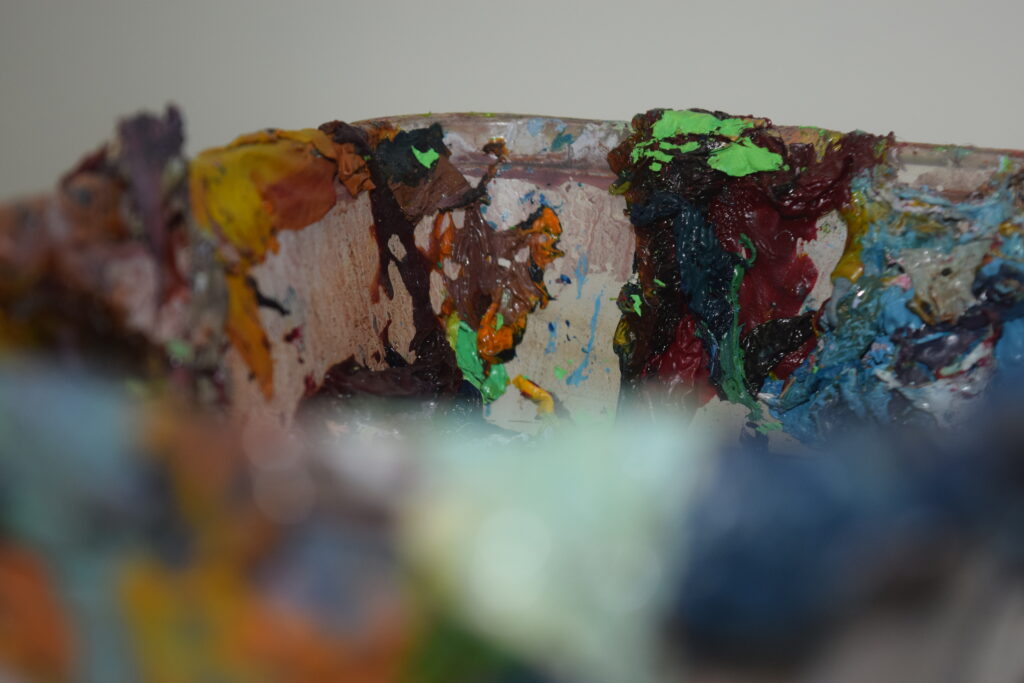
Close view of a dried palette, showing thick layers of paint and residue.
I began photographing these palettes from above, from the side, and close up. I wanted to study them with the detached care of a forensic record, while still allowing their strange force to remain. They are ugly and lush at once. They hold pleasure and failure in the same body. They still carry the seduction of colour, but that seduction now feels trapped inside a dead end. What once served painting now survives as its aftermath. In that sense, the palettes say something the finished paintings never could. They show the process after its promise has collapsed. Pigment becomes political before it paints and illustrates politics. Now, pigment reveals the relationship to power before it depicts the authority.
The still image from the film moved through a similar change. Once printed and installed, it no longer functioned only as documentation of an act that had already happened. It became an after-image that re-entered display spaces, carrying the memory of destruction with it. That matters because the image returns to institutions after the paintings have already been denied to them. The fire happens once, but its image keeps appearing in galleries, residencies, and exhibitions, asking an awkward question each time: what does it mean to show the end of painting inside the very structures that once gave painting its place, its prestige, and its market life?
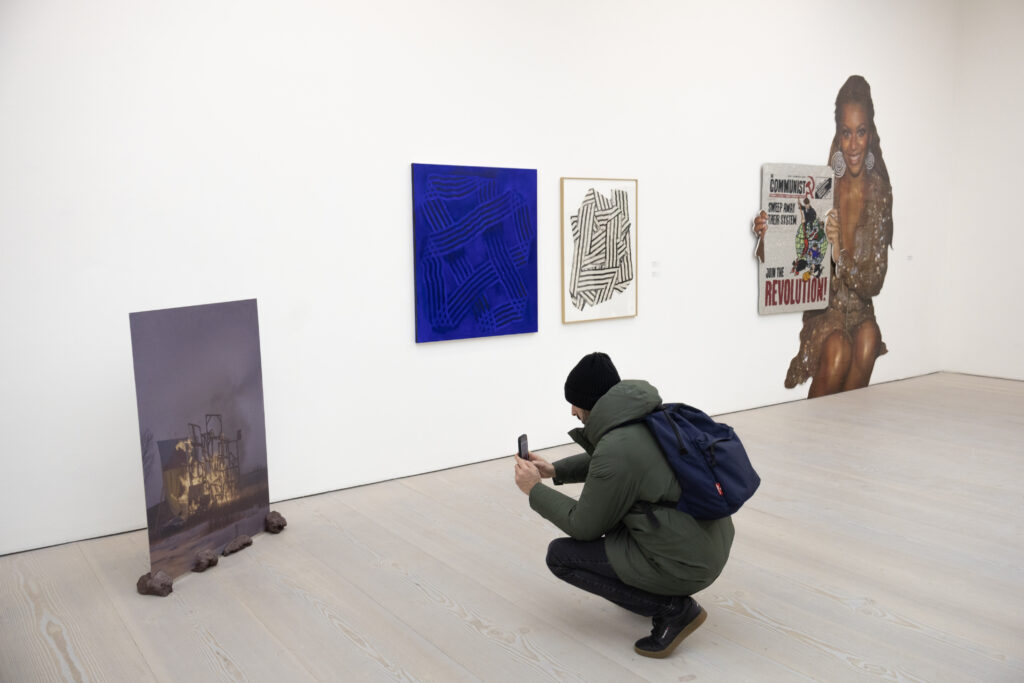
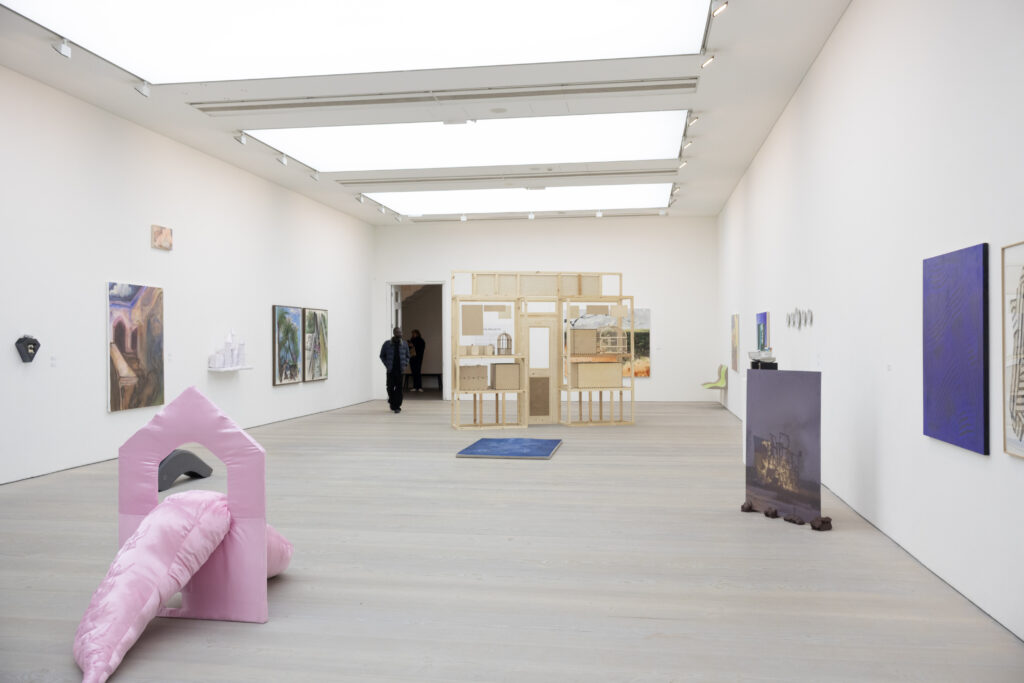
Installation view of a still from The Sight is a Wound, printed on aluminium and held in place by pieces of clay mixed with the ashes of the burned paintings, presented in Good Eye Projects 2026 at Saatchi Gallery, 29 January to 1 March 2026. Image courtesy of Good Eye Projects and Saatchi Gallery. More information here.
I do not think the work offers an answer. I do not trust answers very much here. What it offers is a pressure point. A refusal to continue as though image-making were innocent. A refusal to let painting quietly resume its habits after the world has changed around it. A refusal, too, of the art world’s talent for absorbing every crisis into discourse, every wound into form, every ruin into display. That machine is still running. I know this work enters it as well. There is no clean outside. But there are still gestures that jam the surface, delay the smooth flow, and force another kind of encounter.
That is where the work stands for me now. A film born from watching livestreamed genocide in Gaza. A fear that turned toward Iran. A studio stripped of comfort. Palettes, ash, and installation views that do not rebuild what was lost, and do not pretend to heal it. They stay with the remains. They ask what an image becomes when it can no longer bear the weight placed on it, and what kind of creative practice, philosophical drill, or maybe even political imagination is still possible after that breaking point.