
Words by Ismael
Artworks by Moustafa Kridly
Lovers develop a language of their own. They make up new words to refer to each other or use existing structures and transfigure them to reflect their shared, intimate realities. As such, even ordinary words start evoking longing, ecstasy and proximity.
And when you gaze into God, the lover of lovers, which words would untie your tongue? Which metaphors would be the mirror of the most splendid face? Because “whichever way you turn, there is the Face of God” (Quran 2:115). I wanted to talk about Him, understand Him. But the language I have inherited was shackled by frozen interpretation, moral prescriptions and internalized fears. It speaks of God but seldom with Him.
This article is the retracement of a journey. It tells the story of a religious language I have received, learned without any willful intention, only to become a language I consciously inhabit. I left Islam in anger, in weariness, and returned to its abode in a renewed form, liberated and profoundly incarnated in my unique self.
Today, I consider religions as spiritual languages. I noticed how religions are inscribed in a historical context, show diversity and fluidity, and documented changes across centuries. Similarly to languages, religions are porous: they inherit myths and wisdom from each other, they share worldviews and tools. And in that same logic, religions can be mechanically spoken or become vehicles of poetic and spiritual flights.
I grew up in a Muslim country, where Islam is transmitted as a mother tongue. Very early, I knew how to pray, when to lower my gaze, and what to murmur in each position. What was supposed to be the innermost secret of the soul, and its very link to divinity, was often reduced to empty devotions. Moral rules pertained to every aspect of society through forbidden acts and thoughts. But without the self reflexive, endless inquiry, that could enliven a moral framework and make it a creative, useful bedrock for people.
Thus, religion grew to be stale and monotonous. The judgmental and somber preachers of men contrasted with the radiating presence I was feeling, filling the Earth, reminding me that “God is the light of the heavens and the earth” (Quran 24:35). The intricate infinity suggested by sacred geometry in mosques clashed with the finitude that was closing in on me.
A question then had quietly settled in: why bother claiming Islam at all?
By the end of university, I didn’t consider myself Muslim anymore. The word became too heavy to bear. I didn’t want to carry control, violence, and sexual norms. I left Islam, and soon after my home country. Setting sail to France, I discovered and started learning new languages, existential in nature.
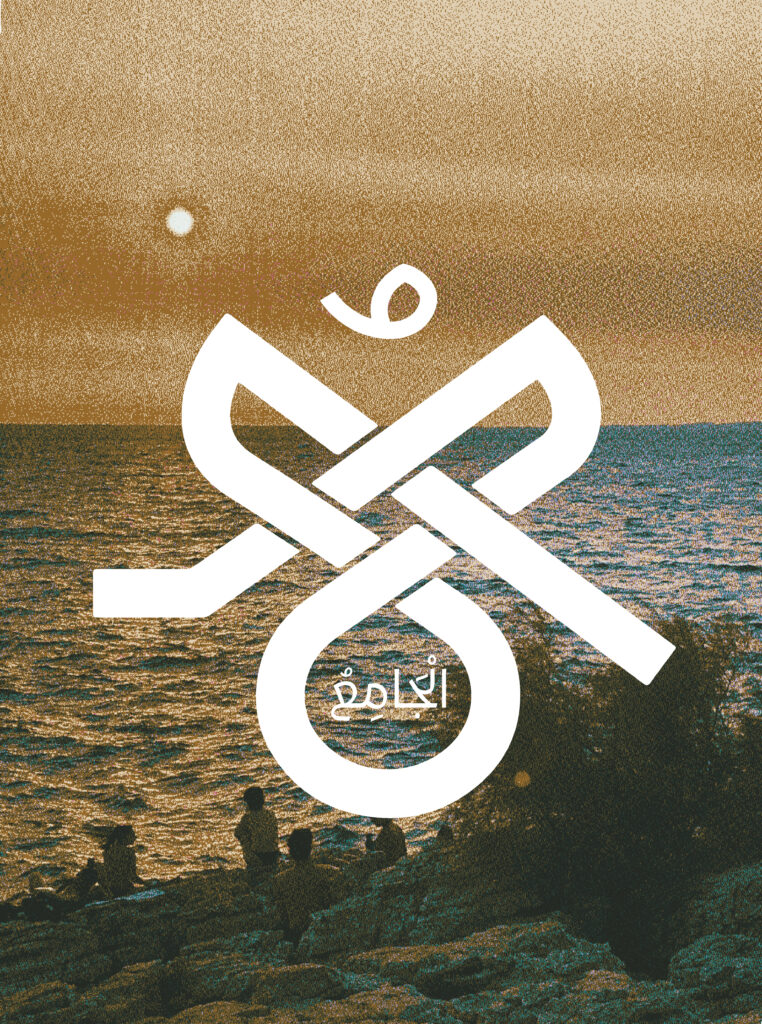
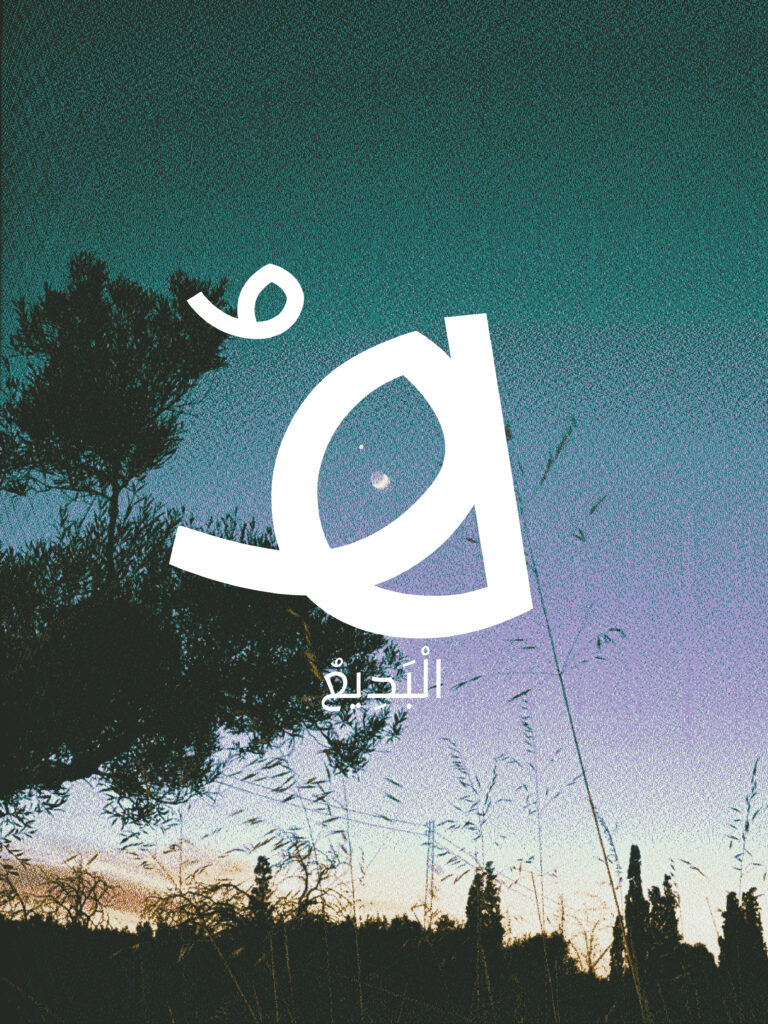
Artworks by Moustafa Kridly
Two variations of the Arabic letter hāʾ (ه) reflect how letters, like language itself, can shift and morph to express different states of feeling and meaning. Set against a natural and intimate background, the forms draw on Huwa (هو, “He”), as used in Sufi dhikr, a reference to the spirit of God. Each letter also encompasses a more classical invocation of one of God’s names in Islam: the first Al-Badīʿ (البديع), “The Originator”, and the second, Al-Jāmiʿ (الجامع), “The Gatherer”.
As an Arab migrant in France, queerness didn’t come as a ready-made label, to be paraded. It was praxis. It was a slow construction of the self, a building of a sanctuary that would house new forms of relationships, new affects, new strategies to confront oppression. A praxis of the oppressed. In this sense, the queer subject isn’t a detached auto-creation. It is a constant examination of everything that molds us from dominations, precarity, colonial heritage, to gendered violence. Everything we must look in the face and confront, acknowledging the indelible marks on our body and mind that stand witness to our suffering.
And yet, queerness carries hope. Like faith, it is “the bird that feels the light and sings when the dawn is still dark,” as the poet Tagore declared.1 As I witnessed the queers singing, among the ruins of the world, there resonated a shared chord between faith and queerness that rippled across my life. From clubs deep in the city to demonstrations in the streets, the clamor of bodies reminded me of that pulsating presence. In our tentative unity under the strobes, in our solidarity against oppressions across the globe, and our laughter during improvised dinners, something shifted. In the folds of our most fragile humanity, elations sprung up from queer love, calling for God.
But there was also noise, turmoil, and restlessness. I wanted to make more inner space for God’s grace; and I saw the risk of it dissolving into ephemeral feelings. I wanted discipline, an attentive cultivation of these yearnings of the soul that would sustain my spiritual aspirations. It is then that my Islam started resurfacing. In Islam, I had access to an ocean of knowledge where others have swum, wisdom accumulated through the ages and divine words that continue to bring me insight and comfort. But how do I make this tradition mine, translating it into the newfound complexities of my life?
A hint comes from gay sailors and circus performers. At the start of the 19th century, queers in England developed a lexicon called Polari. Polari resulted from the combination of words and idioms from various languages and slangs. Its legacy still lingers in some words we use now such as camp, butch, or trade. Back then, it enabled them to express their revolutionary desires, cruise safely or ridicule the authorities. In a gesture of detournement, they were dealing in secret communication right under the nose of their perpetrators and uttering words in languages that were only used to deride and violent them.
Similarly, I realized that I can use the language of my inherited religion in innovative forms that would reflect my own subjectivity, and be rooted in the material conditions that we currently live in.
I know now that I have the power to make my prayer a dialogue “alone with the Alone”. To make my fasting a sharpening of my mind and an enlargement of my heart. To make religion a space where the predatory forces of capitalism and morbid nihilism loosen their grip. Far from any escapist spirituality, I grew to see Islam as a forge to bring forth “word[s] of truth spoken to a tyrannical ruler”.2 Indeed, one of the Islamic names for God is Al-Haqq, the Truth. Displaying fidelity to the divine is then displaying fidelity to truth wherever it lies, may it be against all established orthodoxy.
Yes, it is often unsettling, costly in solitude or misunderstanding. It demands constant vigilance, an effort to attend to God’s call for justice and compassion. It is a call whispered in hushed tones, that knocks softly on one’s soul. I am learning to listen and to answer God’s call for justice and compassion. To answer with my whole self, that which embraces all my friends, lovers, and the living beings that grace my life.