
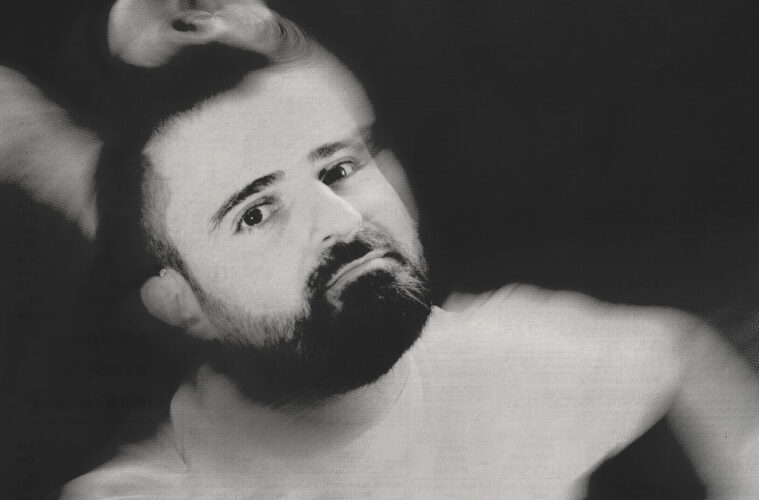
In conversation with Khalid Abdel-Hadi
Photography by Asmaa Hamdi
Photo Design by Alaa Sadi
Translated by Hiba Moustafa
This piece is a supplement within the “Sana wara Sana” issue
Palestinian-Lebanese journalist and editor Elias Jahshan has been at the heart of a growing archive of queer Arab storytelling. His first anthology, This Arab is Queer (Saqi Books, 2022), broke ground by bringing together LGBTQ+ Arab voices from across the world, refusing both western caricatures and regional silences. Now, with his upcoming collection This Queer Arab Family, Jahshan turns from the individual to the collective asking what family, belonging, and kinship mean when queerness and Arabness meet.
In his second conversation with My Kali, Jahshan reflects on editing across difference, building solidarity through story, and reclaiming joy as a form of resistance. From Sydney’s Club Arak to London’s queer Arab parties and beyond, his work traces how queer Arabs find one another, and how these connections become home.
Building on the success of This Arab is Queer, what inspired you to curate This Queer Arab Family? How does this new anthology differ in its exploration of queer Arab experiences?
Amidst all the feedback I received for This Arab Is Queer, and all the panel discussions and book events I took part in, there was one question I was asked time and time again: whether I would edit another anthology of queer Arab stories.
I’ve always maintained that I did not want to do a straight-up sequel. If such an anthology were to be done, it should be steered by a different editor who can bring their own insights and approach. So if I were to edit another queer Arab anthology, a completely different approach was needed. One that required exploring a niche angle, with unique stories that are rarely, if ever, told through these lens. It needed a focus, and a focus that had meaning.
The newfound connections I made through This Arab is Queer, both parasocial and in real life, allowed me to reflect on how queer Arabs find community and/or family (biological or chosen), and the role in which their intersectional identity plays in all of this. This, in turn, allowed me to reflect on my own journey of seeking community and kinship with other queer Arabs, whether it be in London, where I live, or Sydney, my hometown, or online.
It wasn’t until my mid-twenties, several years after I started my coming out journey, that I truly discovered myself and embraced my intersectional identity as a gay Arab. It was all thanks to Club Arak, a queer Arabic music dance party in Sydney that was run by queer Arabs for the queer Arab community. Club Arak allowed me to explore the joy of being gay and Arab at the same time, rather than compartmentalizing these identities. It helped me overcome the shame that riddled my teens and early 20s. This in turn gave me the courage to be my authentic self away from the dance floor, especially with my family.
Moving to London nine years ago meant I had to start all over again in meeting other queer Arabs. In my third year here I discovered the Pride of Arabia parties and book club, which gradually snowballed into other queer Arab community events, WhatsApp groups, and parties. It was also through activism that I met other queer Arabs, with comradeship forged through marching together in pro-Palestine protests or London Trans Pride, or attending a vigil for Sarah Hegazy.
My journey with sudden hearing loss and cochlear implant surgery in 2023 also allowed me to reflect on family and community. My hearing aid was no longer providing me with clarity in sound, which led me to avoid large social gatherings. Not to mention being on the other side of the world from my family. I missed being involved in queer Arab community events and gatherings, and I missed having my loud family around me. It was a year of feeling socially isolated. I truly underestimated how innate these connections were needed in my life.
Thankfully, my cochlear implant surgery was a smashing success. Soon afterwards, I had a few meetings with my publisher Saqi, where these reflections were discussed. Before long, the focus of my next anthology became clear.
In This Queer Arab Family, writers share complex, nuanced stories that go beyond the individual. Themes take on a family and community-centric approach. More importantly though, This Queer Arab Family aims to show how there is an abundance of joy in queer Arab families and communities. It aims to reclaim the narrative of family in Arab cultures. It is also a way of asserting our existence in cultures – both western and Arab – that want to erase us. These stories prove that we are family, too.
Looking back, at This Arab Is Queer, what critiques, reflections, or feedback did you receive and how did those insights shape the curation and vision of This Queer Arab Family?
As editor of This Arab Is Queer, I was fortunate to meet and speak with many queer Arabs around the world, both in-person and on social media. It opened countless doors for me, and I was humbled by how the book was so positively received by readers around the world. I always felt joy when Arab community members who were not queer expressed praise and support for the book in a public forum ; it not only proved we have countless allies in our own communities, but it also challenged the racist trope that our queer identity is always in conflict with our culture.
However, the readers whose feedback meant to me the most were fellow queer Arabs themselves. The book was meant for them first and foremost, after all. I have lost count of the number of times queer Arabs have approached me at events, or via DM on social media, expressing how much they enjoyed reading This Arab Is Queer, and how much the representation means to them. Other heartwarming moments include friends and acquaintances taking – or smuggling, even – copies of This Arab Is Queer with them to the SWANA region to safely give to their friends, and documenting it with images sent to me via WhatsApp or Signal accompanied by a message on how much their friends will cherish the book.
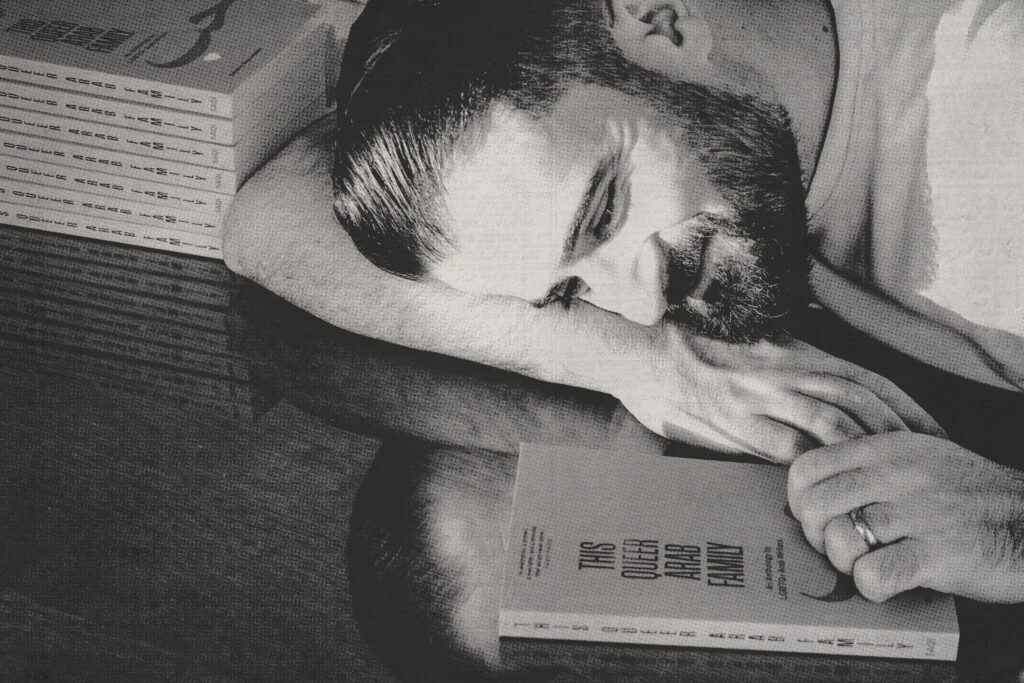
Photography by Asmaa Hamdi and Photo Design by Alaa Sadi
Of course, the critiques from This Arab Is Queer can’t be ignored either. If anything, I expect critiques and I’m always open to discussing them. One critique I had was how there was a lack of Maghreb representation. This was admittedly a tricky one to navigate. I knew a few queer writers from the Maghreb, but obviously not enough. But I am also conscious of how the “Arab” identity is a constant topic of debate in Maghreb countries and communities, and rightly so – under no circumstance would I ever want to erase Amazigh or Kabyle cultures, identity, and language. The writers I had invited to submit self-identified as Arab, but they couldn’t commit with the deadlines I was dealing with at the time.
The other common critique I encountered with This Arab Is Queer was the book’s accessibility, mostly because it was published in English first. I am conscious that in many corners of the Arab world, being able to speak English means access to education, a privilege that isn’t necessarily extended to everyone. So it makes the book out of reach for queer Arabs who are not fluent in the language. And while I would absolutely love to have the book translated into Arabic to make it more accessible, to do so could also be risky. When it’s in English, it plays into the common trope from bigoted authority figures or religious fanatics who claim that queer people do not exist in the Arab world. They can simply overlook it. Translating it into Arabic would (rightly) flip that trope on its head — but it could also run the risk of drawing the wrong kind of attention and expose the book, and each of its contributors, to backlash in society and the media. And while I am sure there are some Arabic-language publishers who would love to translate the book and sell it in bookshops across the region, they’d still have to navigate archaic censorship or so-called “morality” laws that vary from country to country.
However, perhaps the biggest critique I had was around the balance of representation – that it needed more trans or non-binary voices, more stories from the Gulf, more from Palestine, more women, and more bi voices, not enough Black Arab voices, etc. If I had a bigger budget to pay more writers and include more chapters, and also more time, then maybe I’d have come close to achieve the ideal balance in representation. But I had to accept early on that no anthology will ever perfect this balance, regardless of whatever budget or process is behind it. People will always find something to critique, no matter what – and that is perfectly fine. In my opinion, what is more important is to focus on the stories, to ensure they are all unique, and for these stories to resonate with readers (especially queer Arab readers). This was naturally at the forefront of my mind when starting the process for This Queer Arab Family.
Could you share the process of selecting contributors for this anthology? What criteria did you use to ensure a diverse representation of queer Arab voices?
With This Arab Is Queer, I selected my writers through a process of personally inviting them to submit. I ended up approaching around 45 potential queer Arab writers – most of them were established writers or journalists, with others being artists or activists whom I thought had an interesting story to tell. I didn’t really have a set criteria, but I did approach writers from across the LGBTQ+ spectrum and around the world, with a mix of writers in the diaspora and on the ground, and from all generations. The criteria for each of these writers was simple: to write about whatever they felt like, provided it was non-fiction, personal, and touched on their queer Arab identity in an direct or indirect way. Essentially, the microphone was theirs. In the end, 20 submitted by the time deadline rolled around. I unfortunately only had a budget for 18 chapters, so I had to make the difficult decision of turning down two of the submissions. None of the chapters published in the book were translated – they were all written and submitted in English. But I was really lucky that each of the stories were so unique with barely any overlap.
For This Queer Arab Family, the process was very different. Not only was it fewer chapters but longer wordcounts for each chapter, it also features more emerging writers than established. This Arab Is Queer had a mix of non-fiction writing but the personal essay genre was most common. With This Queer Arab Family, the collection leans more into the short memoir genre.
Of the 10 chapters in This Queer Arab Family, half were written by contributors who were invited directly to submit, while the others were selected from an open call for submissions. I was blown away by the response to the open call: 92 submissions were made – far more than what myself or Saqi Books had anticipated given the niche focus.
The downside of this is that it made it hard to achieve a balance of writers in the final line-up in terms of their gender, location, sexuality, nationality, and more. But as I mentioned earlier, to even achieve a perfect balance in any anthology would be impossible. I had to focus on the quality of the stories, and ensure the final collection touched on a wide variety of themes and experiences.
Either way, it was a joy and privilege to be able to read each of the submissions. While the vast majority were in English, nine were written in French, and two in Arabic. The writers represented the full range of nationalities from across the Levant, Gulf, North Africa and Mesopotamian regions, and were a mix of those living there or part of the immigrant diaspora. The diversity in locations of the writers proves how there is no one right way to be Arab or queer Arab, and that no hierarchy of such experience should exist either.
Reading all of these submissions made it a long and difficult process to shortlist the pieces that would go on to become chapters in This Queer Arab Family. But the pieces selected all met the brief in their unique ways, which was key.
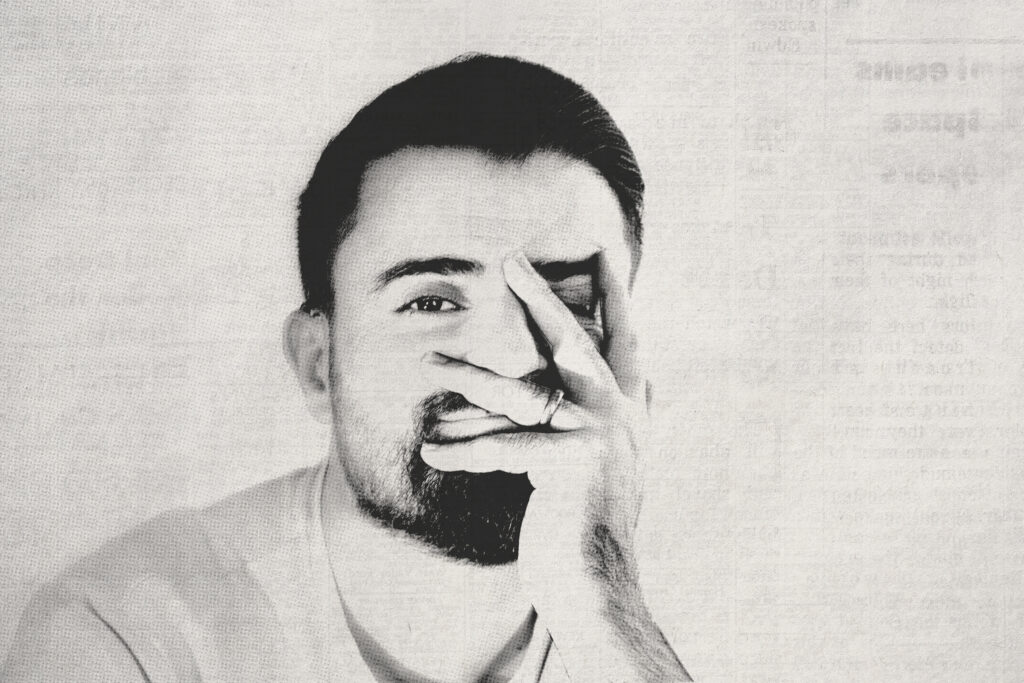
Photography by Asmaa Hamdi and Photo Design by Alaa Sadi
How does This Queer Arab Family shift the focus from individual narratives, as highlighted in the previous anthology, to the concept of chosen family within the queer Arab community, and in doing so, how does it challenge, critique, or potentially reinforce traditional notions of family in Arab cultures while contributing to the redefinition of familial bonds?
For many of us, whether we are queer or not, the importance of family is ingrained in our psyche from a very young age – much more so than in western cultures. It’s not uncommon for Arabs to have an ingrained belief that the role we play in our families, or the things we do and achieve in life, can have an effect on the respect our parents and siblings command in the community. The risk of losing one’s family, or being responsible for our family’s standing in the community, can be too great to bear – regardless of whether or not we come out to them. This is exacerbated with a common fear that our true identities could bring shame on the family, lead to excommunication or worse yet, place our safety and wellbeing at risk.
While we’re led to believe that family is everything, as queer Arabs we don’t really see ourselves reflected in it. The discourse in our culture only seems to allow room for the traditional nuclear family, one where the parents are opposite genders and the children they bear are expected to carry on the legacy of the family tree, especially via the sons. The framing of any discussion around families – whether it be positive or judgmental – often places an onus on the parents, especially the father.
Essentially, we have to navigate a cultural discourse of family ideals that’s entrenched in heteronormative norms and patriarchal traditions. For those of us in the diaspora, especially in western countries, we have the additional layer in dealing with a discourse around queer families that is often dominated by white same-sex couples.
I do hope that This Queer Arab Family challenges these norms. Some readers may note that a few stories in the book do indeed reinforce traditional notions of family in Arab cultures – but I still believe they contribute to the redefinition of familial bonds. For many Arabs, including queer Arabs, the concept of “chosen” family may seem odd. There is so much focus on biological family that anything outside of this seems alien.
This is why I was keen for writers to explore what family means to them, and that family doesn’t have to be family in the traditional sense – it could also be about community and comradeship, safe spaces, parasocial connections, and more. Family may be the cornerstone of Arab cultures, but I hope this book proves there are so many ways for us to forge kinship with others.
Each of the writers in This Queer Arab Family articulates how they move through family dynamics as queer Arabs with honesty and integrity. They are forging new ways, while remembering old ones. Each piece is raw and reflective. They acknowledge the realities we face, while also offering hope for what the future has in store for us.
Given the ongoing challenges and trajectories faced by queers and Arabs, how did that affect or influence the curating/editing process? What do you hope readers will take away from This Queer Arab Family?
Of course, Palestine, and the emotional impact that Israel’s genocide in Gaza has had on our community, all come up at varying points throughout the book – in fact, there is a whole chapter that honours Palestinian motherhood in a time of genocide. There are also chapters that are contextualised around the Syrian and Sudanese wars, or Lebanon’s economic and political crises, or a lack of nuance and understanding of trans patients in the medical field – but the stories are not about these, per se. It’s the writers and their personal experiences that are the main characters, and they don’t necessarily respond to current challenges and trajectories directly.
It would be easy to curate a book that responds to current or recent events directly – but this runs the risk of giving the stories a short shelf life. While that may work for other forms of media, such as magazines or newspapers, for books you have a lot more flexibility to be open-ended. This is why I believe it would be more effective if the stories in this book – and the previous anthology, too – weren’t so direct. I want it to be fresh and impactful for readers in ten, twenty or fifty years’ time, just as it would be for readers if they picked it up from their local bookshop or library today.
My hope is that readers can learn about some of the nuanced stories of queer Arabs forging kinships and celebrating culture on their own terms, holding space for one another through activism and community solidarity, navigating their place in the family – or their own journey to parenthood. I want readers to realise that it’s not just white western queers who can have these stories. I want readers to realise that the orientalist tropes, the overused and reductive ‘passive victim of a violent patriarchal culture’ narrative, or even the ‘perfect refugee’ narrative that are imposed on us in the media or social media discourse are harmful. It’s important to show that we can speak for ourselves and that we don’t need permission from gatekeepers in the media or in western queer communities, who still seem to set the standard for queerness, to tell our stories how we want to tell them.
Reflecting on your own journey, how has your understanding of queer Arab identity evolved through the editing of these anthologies? And how do you define “queer Arab”?
One interesting thing I’ve come to embrace and nurture over the last three or so years is my belief in pan-Arab solidarity. I’ve completely unlearned the tendency to centre Shami Arab experiences in queer Arab discourses. I also tend to refrain from using pan-Arab ‘nationalism’, not just because it’s unrealistic but because it implies putting an onus on the nation-state and nationalism. Pan-Arab solidarity, in my opinion, is more about centring the people and celebrating our differences and glorious diversity.
Given that we are a minority in our cultures, this sense of pan-Arab solidarity is exacerbated, in my opinion. And that’s not a bad thing! This solidarity I feel with other queer Arabs means we can relate to each other despite our differences, and are more keenly aware of our different challenges. Pan-Arab solidarity, I feel, we have among queer Arabs also means we need each other, and offering support for another is key as we continue to fight for liberation on so many fronts.
For me personally, queer Arabs challenge, disrupt, or move beyond established social and cultural norms, particularly those related to sexuality and gender. Our mere existence does this in any case. There is no one right way to be queer and Arab – we all have our own unique path, and they are all valid. But for me, to be queer Arab means we are actively or subconsciously disrupting what is considered “normal,” “expected,” or “taboo” within our societies. We may not have a choice in the matter, but our mere existence plays a role in the deconstruction of existing societal taboos and conventions, such as the heteronormativity of family structures. We are building an exciting new future full of new possibilities for identity and relationships. And none of this is conflict with our culture – I hope my book proves that.