
Words by Ahmad Halloum, queer psychoanalyst based in Paris.
Translation by Hiba Moustafa
Artworks by Aude Nasr
This article is part of the “Sana Wara Sana” issue
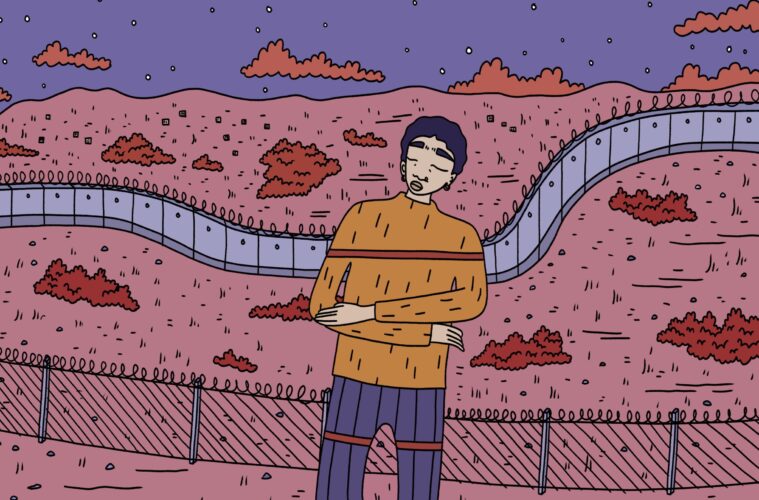
Borders don’t just divide land. They slice psyches. Violence seeps into queer lives in quiet, cruel ways: fear that sits in the gut; shame that never belongs to us but clings anyway; the self scattered across time and place, always trying to return but never quite arriving. Despite this, resistance breathes. It hides in quiet solidarity, in mutual support, in secret therapy circles, in communal mourning that feels like both rage and prayer. There is something raw about that resistance, the stubborn desire and act of wanting to live, in a community, even when everything around you says you should not.
Narratives are never tidy and organized. This is not about post-traumatic growth. Healing is not a checklist. Rather, it is an insurgent witnessing of staying with the fragments, the somatic1 screams, the fractured self, long enough to turn symptom into signal, silence into speech, terror into testimony.
In the clinic, I witness how the body portrays memory in ways words often cannot. I see and hear it every day: hands that tremble in stillness, nights where sleep refuses to come, silences that stretch longer than the clock can hold. These are not symptoms to erase but a language of survival, a vocabulary of pain and persistence.
Borders take many shapes. Some are physical; checkpoints, walls, exile.2 Others are social; between visibility and invisibility, public safety and private risk, family belonging and rejection. There are also psychic borders, the fragile thresholds where memory and identity fracture under pressure.3 And as such, these borders produce silence, rage, and the uneven texture of survival. Silence when speaking means danger, rage when erasure becomes unbearable, and survival in the small acts of navigating between one side and the other. These borders not only surround queer lives, they cut through them, inscribing memory into the body and turning everyday existence into a negotiation with power.
The Symptom of the Border
One patient, A., a nonbinary person from the Occupied West Bank, experiences panic every time they cross a checkpoint, not just fear of violence, but a terror of identity shattering. Their symptom is the border itself, not only an external constraint, but an internal collapse.4
A., sobbing with grief, once lashed out: “Why aren’t you angry? You’re too calm.” The rage, immense, private, uncontainable, spilled into the room. I leaned in and whispered: “I am angry.” That moment shifted everything. It was no longer just grief, it became an alliance of rage. This is not traditional therapy. It is a radical, border-shattering encounter, where silence and rage coexist as survival.
The Weight of Memory
In the room, silence is never empty. It is charged, heavy, almost alive. Patients carry in their gestures what they cannot yet speak. Some stories arrive loud with rage, others barely rise above a whisper. Memory, too, weighs in — not as a tidy chronology but as fragments, flashbacks, sensations that return uninvited. It clings to the body in trembling hands, in the refusal of sleep, in words left unsaid. Silence, rage, and memory all stay with me, and echoes of the violence that shaped them.
These fragments of silence, rage, and memory take different shapes in the lives of those I sit with. Each patient brings their own border, carved differently into body and psyche.
R.
There is R., in their twenties, who has survived what many did not. Survival, however, carries its own torment. Their family is still in Gaza, living under constant bombardment, an engineered famine, and genocide. Every phone call, every message, carries the possibility of unbearable loss.
They speak often of survivor’s guilt, but theirs is layered, not only guilt for being alive, but for being queer while alive. “Sometimes I wonder,” they whisper, “why do I get to breathe here when they can’t.”
Each conversation about home is tight with fear and longing. In session, we sit with the impossibility of holding both truths, the need to live and the unbearable heaviness of doing so when others cannot. For R., survival is not relief. It is a haunting, a fracture, a life split across two worlds. Here the border is the body itself, carrying the weight of survivor’s guilt, where even private mourning is impossible because public catastrophe never ends.
M.
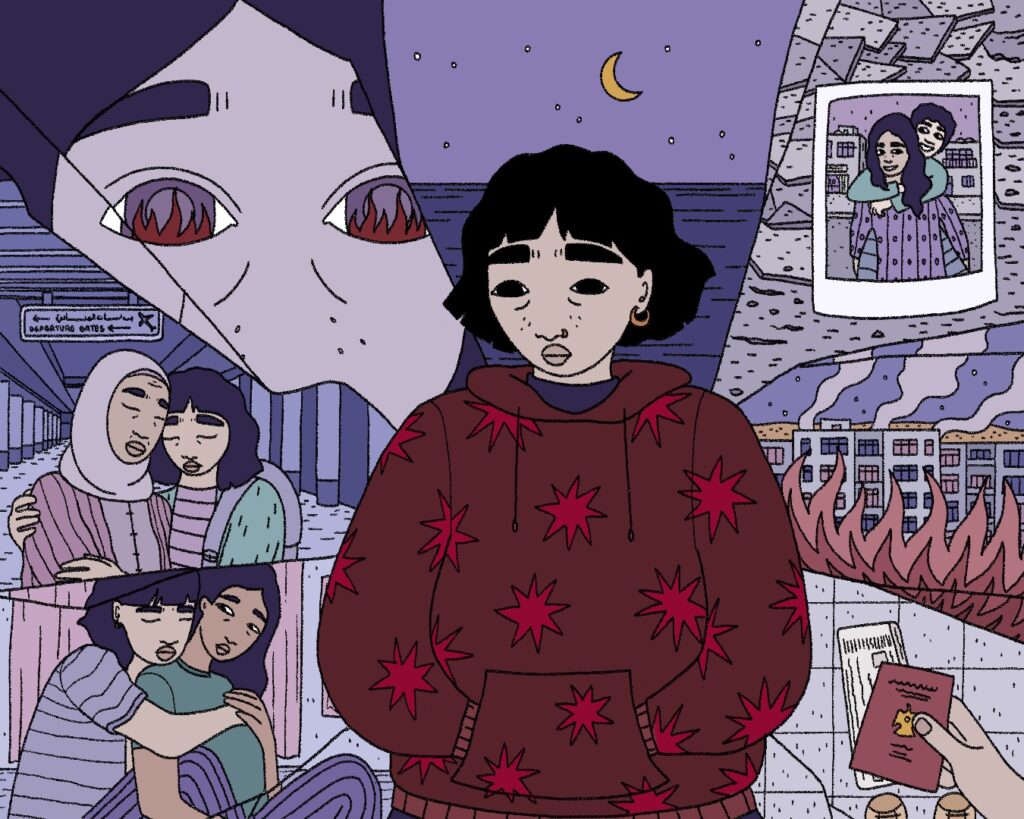
M., sharp and measured, spent years in Cairo where even the simplest things; a shared dinner, a quiet evening with friends, a walk through familiar streets, carried a shadow of risk. Police often target queer people via public spaces or through digital means: dating apps with location features are used by authorities to entrap users; phones are searched, chats and photos used in prosecutions.5
And yet, there were moments of light. The ephemeral thrift shops and underground art spaces became makeshift havens, places where, for a few fleeting hours, queerness could exist without fear. “Even happiness felt temporary,” she told me once. “Like everything beautiful was built to vanish.”
That impermanence followed her, etched into her posture, the way her eyes scan a room before sitting down, the way safety always feels conditional. For M., the border was not only the police raid or the threat of arrest, but the way the state made intimacy a public matter. A kiss could be evidence. A phone could be a weapon turned against its owner. The line between private and public was erased, and her psyche was forced to live in that collapse.
Artwork by Aude Nasr
Y.
And then there is Y., from Tunis, who has spent years living at the edge of visibility. There, activism is a dangerous dance, a constant calculation of how much of yourself the world is allowed to see.
In session, he speaks in fragments; silence follows after. Here, waiting leaves a metallic taste. And laughter becomes survival. “You laugh,” he says, “because if you don’t, you forget how.”
His humor is quick, sharp, exhausting, becoming a shield honed over years. Underneath is a body that has learned vigilance is the only form of safety. Slowly, week after week, he learns that vigilance is not the only way to survive, that there can be room for softness, even now. For Y., the border runs through visibility itself. To speak too loudly, to be seen too clearly, is to risk annihilation. Yet to hide is another kind of temporary death, a self-erasure that eats from within. His vigilance is not only a defense, but a symptom shaped by the constant threat of being both exposed and denied at once.
The Borders Within
What ties them together is not only trauma, but the way the world has carved borders into their lives. Borders between safety and danger. Between home and exile. Between being seen and being erased. Visibility can bring recognition, community, even fleeting safety, but in contexts where queerness is criminalized, it also invites surveillance, harassment, or attack. Erasure, on the other hand, means survival through silence and invisibility, but at the cost of isolation and self-denial. These dynamics are seen in the queer Arab glossary spaces too — when some terms are reclaimed, others are censored.
These borders are not only political, they are psychological. They run through dreams, through relationships, through every fragile thread of identity. In the room, they are everywhere. In silence that weighs like stone, in hands that cannot stay still, or in outbursts that strike like lightning, brief, scorching, impossible to ignore.
Being in session with them is not about offering answers, it is about witnessing. It is about holding the rage when it comes like a storm, without flinching. To sit in silence when there are no words. And refusing to turn their pain into a neat, digestible story for the comfort of others.
Silence. Rage. Survival.
These are not just words, but the pulse of queer existence in our region today. Lives shaped by checkpoints, by fear of raids, by whispered names passed in secret networks, by the quiet persistence of staying alive.
To witness these lives is to understand that survival is never linear. It folds in on itself, stumbles, loops, and resurfaces. It is not clean. It is not heroic. It is quiet, patient, and stubborn, carried in bodies that have learned to hold both terror and desire at once.
In the therapy room, this survival speaks in silences that are heavy and alive, in bursts of rage that demand to be acknowledged, or even in the tremor of a voice that refuses to be erased. To witness is not to repair, rather, it is to stay, to resist the urge to simplify, and to keep listening as survival in its fractured and relentless form; keeps finding language.
Queerness can be made hyper-visible, exposed through public scandals, while at the same time denied and erased in law, in families, and in daily life. Queer existence here is lived through borders everywhere. They do not just stop bodies at checkpoints; they invade bedrooms, friendships, and the silence of therapy rooms. Law makes intimacy itself a crime. Families expel children for existing the way they choose to. Cities carve queer geographies where a bar or a café can turn from sanctuary to trap in a single raid. Borders do not simply divide space; they carve into flesh, drilling vigilance into the nervous system, fragmenting memory, dictating when desire can be spoken and when it must be swallowed. To live queer here is to be made hyper-visible as a threat and invisible as a citizen at once — a double violence or even double consciousness too written into the body.
- Somatic: relating to the body as opposed to the mind.
- Achille Mbembe, Necropolitics, Public Culture, 2003.
- Gloria Anzaldúa, Borderlands/La Frontera: The New Mestiza, Aunt Lute Books, 1987.
- In psychoanalysis, a symptom is not just a sign of illness but a formation of the unconscious — a compromise between desire and prohibition, where psychic conflict takes shape in the body, behavior, or thought (Freud, 1900; Lacan, 1966).
- Human Rights Watch, Egypt: Security Forces Abuse, Torture LGBT People, 2020.