
Words by Nazeeha Saeed
Artworks by Omar
Translated by N.H.
This piece is part of the “Sana wara Sana” issue
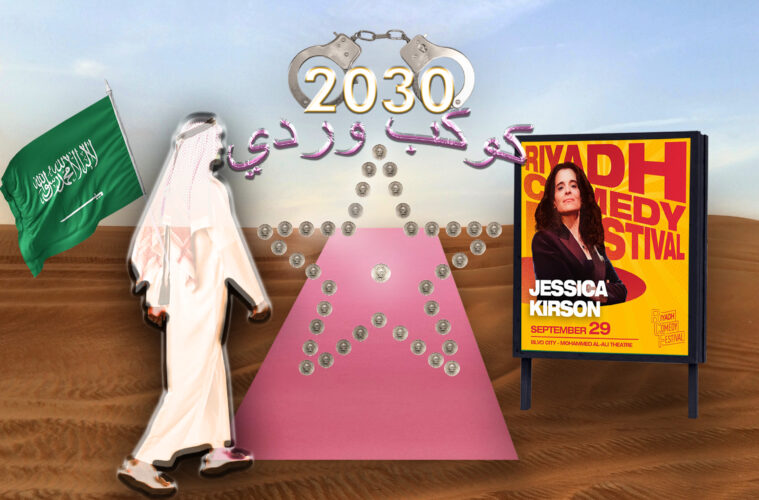
American lesbian stand-up comedian Jessica Kirson has expressed “sincere regret” for her Riyadh Comedy Festival Performance, claiming she wanted to “help LGBTQ+ people in Saudi Arabia feel seen and valued. I am grateful that I was able to do precisely that — to my knowledge, I am the first openly gay comic to talk about it on stage in Saudi Arabia.”
At the same time, she expressed her deep regret for participating under the auspices of the Saudi government, which severely criminalizes the LGBTQ+ community. Saudi LGBTQ+ activists see these steps as part of a government propaganda campaign to polish up its image and sweep violations under the rug.
The Human Rights Watch criticized the festival and accused it of “whitewashing abuses”: “[w]hile the emerging entertainment industry was being lauded internationally, Saudi authorities were simultaneously carrying out waves of arbitrary arrests of dissidents, activists, intellectuals, and royal family members.”
“Comedians performing in Riyadh should speak out against Saudi Arabia’s serious rights abuses or they risk bolstering the Saudi government’s well-funded efforts to launder its image.” said Joey Shea, a Saudi Arabia researcher at Human Rights Watch. However, this was prohibited in the contract that the comedians signed with Saudi Arabia’s Entertainment Authority, which included a ban on “any material that may be considered to degrade, defame, or bring into public disrepute, contempt, scandal, embarrassment, or ridicule the Kingdom of Saudi Arabia.” Jokes about the Saudi royal family or any religion were also prohibited, according to one of the comedians who refused to participate in the festival.
“LGBTQ+ people appearing on social media or in public is not evidence of progress regarding their situation in Saudi Arabia. There is no law to protect them, and laws are still biased against them. I personally support many of the changes that have taken place in the Kingdom, but these changes are being exploited for unethical practices. As far as the LGBTQ+ community is concerned, there are no positive changes, and authorities have repressed all activists in general,” said exiled Saudi activist Alvin Al Qatifi.
The Law
According to lawyer Abdallah Almehleky, in Saudi Arabia, “acts considered to be sexual deviance (such as homosexual practices) are severely dealt with in accordance with Islamic Sharia, which is the main source of legislation in the country. These acts are considered a violation of Islamic moral values and conservative societal traditions, and the punishment for deviance in Saudi Arabia is implemented in accordance with Sharia laws and applicable regulations.”
Almehleky elaborates that Saudi Arabia punishes “deviant” acts that are recognized by Sharia, such as sodomy and lesbianism, if they fulfill the necessary conditions for establishing the punishment, such as an explicit confession or the testimony of four credible witnesses. The punishments are determined based on the provisions of Islamic Sharia (hudud or ta’zir), such as imprisonment, flogging, financial fines, and deportation (for expatriates), in addition to hadd punishments that can amount to execution in serious cases.
As lawyer Almehleky indicates on his website, cases may involve the promotion of homosexuality online, illegal gatherings, blackmail crimes related to homosexuality, homosexuality in work environments, and attempts to establish illicit relationships through apps. There is also an anti-cyber crime law: “[t]his law punishes the use of technology to spread immoral content or encourage prohibited practices with imprisonment for up to five years, in addition to a fine that may reach up to three million Saudi riyals.”
However, legal prosecutions and the use of Islamic law have decreased significantly since the curtailment of the powers of the Saudi Committee for the Promotion of Virtue and the Prevention of Vice in 2016. For decades, this committee served as a religious police force with considerable influence and prestige on the Saudi street. They kept a close eye on the adherence of (Wahabi) Islamic Sharia law in the conservative kingdom.
Among the cases documented by the Human Dignity Trust in recent years was the arrest of a young man in August 2023 by the Commission for the Promotion of Virtue and the Prevention of Vice, who was perceived as gay and charged with “exposing himself to indecency on Twitter.”
In October, gay social media personality Suhail al-Jameel was released from prison after being detained for three years on public indecency charges for posting a shirtless picture of himself on Twitter wearing swim shorts.
In April, a Yemeni blogger living in Saudi Arabia was arrested for advocating for equality for LGBTQ+ people. In July, he was sentenced to ten months’ imprisonment and a fine, followed by deportation, under “public indecency” laws. While in detention he was subjected to solitary confinement, beatings, and torture.
Public Morality and Repression
In June 2022, Saudi Arabia cracked down on the LGBTQ+ community, beginning with the confiscation of any products in the markets bearing the colors of the rainbow flag, under the pretext that “these colors send ‘poisonous messages’ to children and ‘instill homosexuality in the child’s subconscious mind’.”
Among the items confiscated by the authorities at that time were toys, clothes, hats, and pencil cases, all intended for children, in rainbow colors, as part of a campaign against “anything that contradicts Islamic doctrine and public moral codes, promotes homosexual colors, and targets emerging generations.”
In April of that same year, Saudi Arabia banned Disney’s Doctor Strange in the Multiverse of Madness from cinemas because it contained “a reference to the LGBTQ+ community.”
In December 2021, Saudi Arabia expressed reservations regarding a draft resolution on democracy that was presented to the United Nations General Assembly. The draft included the adoption of resolutions pertaining to “sexual orientation and gender identity,” according to a statement read by its permanent representative, Abdullah Al-Muallami. He explained that the draft text of the resolution had been negotiated and references to identity and sexual orientation that had not been agreed upon in previous resolutions had been removed.
In that same month, the Grand Mufti of Saudi Arabia and chairman of the Council of Senior Scholars, Abdul Aziz Al-Sheikh, said that “sexual perversion” is one of the most heinous and abhorrent crimes. That during this era, the whole world has been afflicted with lewd audacity, false claims, corrupt slogans, and abominable deviation, aiming to strip humans of their humanity and of the highest qualities God Almighty has conferred upon them, favoring them over many of His creations.
He reiterated “Saudi Arabia’s firm stance regarding its reservation of the draft text of the United Nations resolution due to the inclusion of identity and sexual orientation terms, which had not been agreed upon, and which contradict [Saudi Arabia’s] historical Arab and Islamic identity.”
Hospitality without Rights
Discourse began to change in 2023 in preparation for Saudi Arabia’s winning of the bid to host the 2034 FIFA World Cup. The Saudi Tourism Authority updated the FAQ section on its website to include the question “[a]re homosexuals welcome to visit Saudi Arabia?” The answer stated that the Kingdom of Saudi Arabia welcomes all visitors and does not require them to disclose their personal information. All visitors are expected to respect local customs and traditions and abide by all laws and regulations.
The exact date on which the website was updated is unknown, but according to CNN Arabic, the archived version of the site, which dates to March 14, 2023, and before that, did not include that question and answer on that page.
It was within this context that Saudi Arabia’s 2034 World Cup Bid Head, Hamad Albalawi, said: “We’ve already witnessed so many developments. You talked about the LGBTQ+ community: we received 27 million tourists last year, and we hosted more than 100 international sporting events attended by three million sports fans. Those fans entered the country, we respected their privacy, they enjoyed their time, and now they are visiting us again. You will be respected here, you will be welcomed with open arms.”
This was also confirmed by Saudi Arabia’s ambassador to Britain, Prince Khalid bin Bandar: “We will welcome everyone… It is a world event, not just a Saudi one, and we will welcome everyone who wants to attend.”
This was commented on by a Gulf activist living in exile who preferred to remain anonymous: “There is an LGBTQ+ presence in Saudi Arabia, but they cannot exceed the limits of what is acceptable in society regarding clothing and expression. They also can’t express gender identity or sexual orientation openly. Nothing from abroad is acceptable, such as pride flags and such, as it elicits the idea of a foreign agenda.”
Tourism on the side
“Saudi Arabia is currently focused on investment and tourism; therefore, it is opening its doors to everyone and training its employees to be tolerant and openminded, all while the laws criminalizing homosexuality, which may amount to the death penalty, remain in place. They are tools in the hands of the government, to use whenever it pleases, but currently, it does not do so for the sake of the country’s reputation, which it promotes as a tourist and entertainment destination, and this is a new direction for the country,” stated a transgender Gulf national activist living in exile, who preferred to remain anonymous.
Saudi Tourism Minister Ahmed al-Khatib announced that the tourism sector has made great progress, with its contribution to the economy rising to 5% in 2023, with an aim of reaching 20%. The “Vision 2023” target of 100 million tourists was surpassed, reaching 109 million by the end of the period.
The Kingdom also plans to boost tourism’s contribution to GDP by investing roughly $500 billion in the sector over the next 15 years.
The activist pointed out that the situation in Saudi Arabia during the past two years is better than before: the LGBTQ+ community cannot express itself in the public arena, but they have their own spaces that are known to them. However, according to him, the acceptance of transgender people is still more difficult than homosexuality in the Gulf.
He also noted that a number of LGBTQ+ individuals living outside Saudi Arabia have returned without being harassed. “But that does not mean they won’t be harassed in the future, and there are no guarantees for their safety from the laws that are not currently being enforced,” he acknowledged.
Al Qatifi believes that the situation of the LGBTQ+ community may be worse now than before: “we used to see some demands, even if they were timid or fearful, on social media, but the situation today, especially after 2021 and the arrest of a number of activists, including the Nahal detainees, has led to an unprecedented silencing of voices within Saudi Arabia and a high level of repression, especially for intersectional and LGBTQ+ voices.”
“From the outside, or even to those living there, the situation may seem like a bubble: beautiful, with freedoms and entertainment, but all of that is directed outwards only, to attract tourists, especially white tourists,” he added.
Al Qatifi described the current situation of the LGBTQ+ community within the Kingdom as “similar to a ‘china set’ for the government, which uses a group of people as a china set for guests at every event, but then they disappear and are dispensed with. The authorities in Saudi Arabia have done this with women and are still doing it.”
“Unfortunately, all of this is propaganda and is similar to how authorities deal with women and the feminist movement: women are arrested for not wearing the hijab in compliance with the law, while authorities appoint unveiled women to administrative positions. The same approach was followed with the Shiite minority,” he said.
“There are LGBTQ+ people who are used in the same way on social media, but when the mission is complete, which is to whitewash the image of the Kingdom, they are arrested and deported if they are foreigners or exiled if they are Saudis,” he added.
Al Qatifi noted that many LGBTQ+ people are in prisons, and transgender people are in clinics and care homes, and that there are discreet, secret gatherings among LGBTQ+ individuals.
Al Qatifi concluded his remarks to My Kali with the following: “I don’t want to be pessimistic. And the revival of entertainment and concerts in Saudi Arabia, if we put aside the ethical and economic aspects, has given some people the chance to experience new settings, but the laws remain inadequate, and there are people who face legal action and are dragged into cases with unjust rulings.”