
Words by Noura Matalqa
Artworks by Lina A.
This piece is a supplement within the “Sana wara Sana” issue
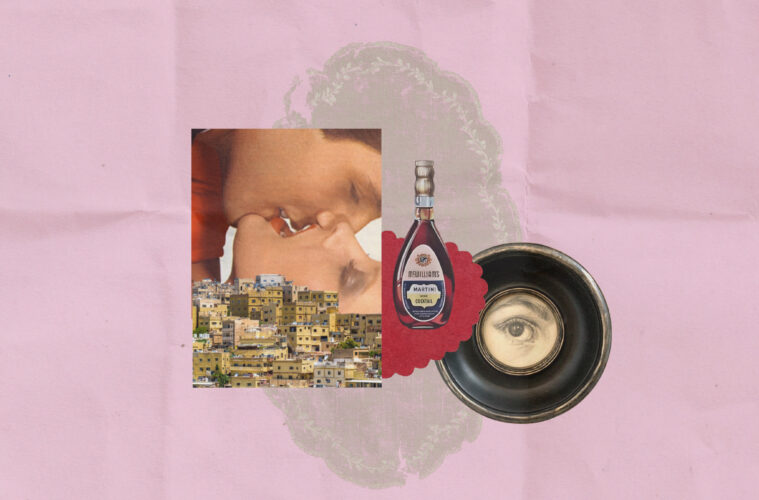
Continents away, shame still found me, with ego on its side. I ran into old school friends at a club on my first night out in London, as an eighteen year old and far from the watchful eyes of Amman society. That night, I kissed someone in the excitement of living in a new city, the prospects of a new life, and a few vodka cranberries. I had never done anything like that before; the concept of getting intimate with a stranger, not even learning his name, knowing that I would never see him again. It was thrilling and terrifying, but was an experience of my own, an experience that I learned from. What I never forgot from that night, is turning around to find my schoolmates sitting around a table nearby, looking at me with disgust. “How was that?” one asked in a disapproving tone. “Forget it,” I said, returning to my modest self in order to protect my ego and reputation, despite having that first taste of shameless drunken free will.
I thought I was ashamed of the kiss. I wasn’t. I was ashamed of being seen. The kiss was more than physical intimacy between two strangers; it revealed a truth I would carry for years: shame travels with us, even when the structures that were once enforced are left behind in another continent. We can feel both the freedom to act and the reflex to retreat at once – a tension between ego, culture, and personal desire that shapes who we are. That reflex, I realised later, was born from years of being watched by family, school, community, religion, gender roles, and the expectations and rules of belonging. We learned to watch ourselves. That night, I realised something I would spend years resisting: shame was not the enemy. My own ego was. What we call “honour” is often just ego wearing tradition as a mask.
To those of us who have carried culture of shame / ثقافة العيب (thaqafit el-e’ib) in our bones, across cities, continents, and timelines, those who know exactly what I mean when I say reputation/ سمعة without explanation, if you’ve ever felt shame sitting beside you at a party, on your phone screen, or in your mother’s silence, know we have a choice to make: should we kill ثقافة العيب , or evolve it into our power?
To kill it entirely would mean pretending shame has never structured our communities, never protected us, never bound us to one another. But to keep it as it is means allowing it to suffocate individuality, especially women’s autonomy, under the guise of honour. The real question is not whether shame should exist, but who it serves: our ethics or our ego. I say we choose to transform.
Culture of Shame, Code of Honour
I remember vividly the first time I learned about ثقافة العيب in school at the age of thirteen: a social code older than any constitution, interwoven in laws and minds, known as culture of shame. It creates social restrictions that often have no basis in religion, such as the concept of حرام or sin. Shaming prevents people from acting in ways that may hurt their families’ – and their own – image or honour. Protecting one’s honour therefore becomes a collective effort, and communities weaponize shame against those who violate this code of honour.
Over time, I began to see the split within shame. There is shame that says: you betrayed your own values. And there is shame that says: you dishonoured our family’s image. What we often call ego is really the residue of a larger inheritance. It served a system rooted in patriarchal authority and reinforced by colonial moral codes that linked women’s visibility, sexuality, and choice to collective honour. It made honour a spectacle with women on its stage.
Growing up, I felt the weight of shame / ثقافة العيب long before I could name it. I learned that every misstep could ripple through my family, turning into gossip, judgment, a reminder that honour is never just personal. I later understood, through reading Hisham Sharabi, that this is a kind of internalised surveillance: we police ourselves before anyone else does. And I recognise now that this policing is tied to ego as much as culture, the fear of losing social standing, of betraying collective expectations, of performing honour rather than living it. We learned to ask not “is this right for me?” but “how will this look for my family?”
Surveillance Turned Inward
Growing up between Amman and London, I’ve seen shame mutate. I would scroll through Instagram stories or TikTok confessions, amazed at the freedom others claimed, and yet, when I tested boundaries myself, I felt that same echo of reputation/سمعة, in the back of my mind or said straight to my face, reminding me that my body, my choices, were never fully mine. I’ve made choices online and offline that my parents would have called reckless, yet I felt a thrill in testing the edges of what I could do without abandoning myself or my culture entirely. The contradiction is constant: to act freely, but still hear the echo of collective expectations.
When shame is tied tightly to ego, it traps us in performance, acting for the gaze of others rather than for our own integrity. We perform for each other.. In turn, ego does not disappear in freedom; it simply changes its audience.
Artwork by Lina A.
From Collective Ethics to Performance Culture
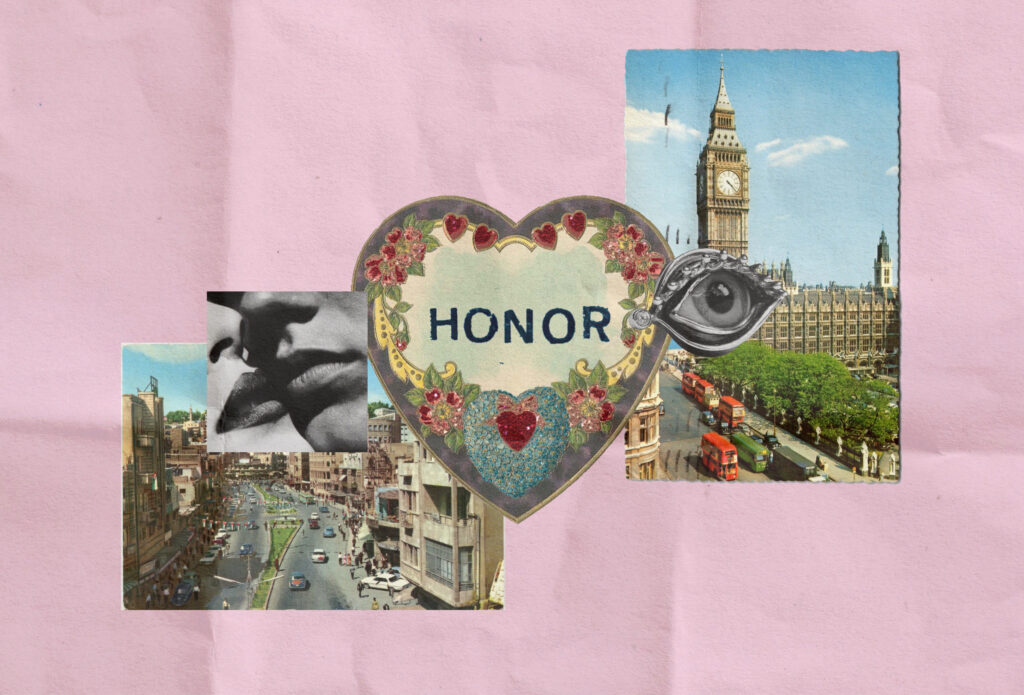
We’ve turned our lives into a performance in ways our parents’ generation never imagined. Posting carefully chosen images, measuring reactions, feeling our morality judged publicly. Honour becomes competitive, about who performs virtues best, and whose family can paint the most dignified portrait. This is how I negotiate my own sense of dignity. As Samuli Schielke writes, morality is never fixed; it is lived messy, contradictory, and often visible before it is private. It is a tension between who we want to be seen as and how we actually live. Social media amplified this. Honour is no longer whispered about in living rooms; it is negotiated in comment sections. When shame becomes a public spectacle, it shifts from ethics to optics.
The question then is not whether culture is changing (culture has never been static), but whether this shift allows collective meaning to deepen, or whether it flattens it into performance. What was once absorbed privately is now exposed, spoken about, resisted. Much like mental health, its discourse hidden for years behind closed doors, shame is being dragged into visibility, forcing us to confront the discomfort it brings. This feels destabilising, but it is also an opportunity to ask: is this shame teaching me something about myself, or protecting someone else’s pride?
Honour in a Changing World
Many of us return to our homelands bearing non-traditional ideas of autonomy, gender, and identity, integrating, if not encouraging, those already there brave enough to be different in the face of what their society deems “normal.” These ideas are often claimed by society to be the death of modesty. The idea of reputation begins to crack when autonomy is no longer seen as selfish.
So what does ‘honour’ mean now? Why does dressing how you want and loving who you want come at the cost of belonging? Is there space for presenting yourself differently while still holding onto your culture? I’ve experienced how honour can be turned into a weapon, to police what we wear, to silence our pain, to make us doubt ourselves. It’s a burden passed down; stitched into our skin. These harmful ideas allow cycles to repeat, passed down through generations. Women carry this burden generationally, as the weight of honour is passed from mother to daughter. Ultimately, shame turns our bodies into a measure of cultural survival. Our clothing, our sexuality, our visibility become symbols of whether a culture is “strong” or “lost.” But culture does not collapse because a woman chooses differently. What collapses is an image. And ego (closely tied to status) cannot survive without an image to defend.
Evolving the Culture of Shame
Perhaps if we choose for ثقافة العيب / culture of shame to evolve, our dignity will no longer have to depend on our compliance. Evolving ثقافة العيب means learning to recognise shame without obeying it. To ask not how to please others, but what integrity looks like when no one is watching. It means to teach the next generation that dignity is awareness, that honour is choice.
Shame can refine and shrink us. It grows on the terrain of the ego: the fragile mask we mistake for tradition. I’ve learned that when we live beyond the need to prove ourselves, when we act from integrity rather than fear, shame begins to fall apart. Not because we’ve become ‘honourable,’ but because we are no longer performing for others. Should we try to be more open about what we are taught to perceive as shameful as a step toward transforming a culture of shame? What if we can evolve ثقافة العيب from weapon to wisdom, honouring our roots while claiming our lives?
I think back to that girl in London, half curious, half afraid. I no longer judge her. She was not dishonourable. She was negotiating the inheritance of culture in real time, and so are we.